


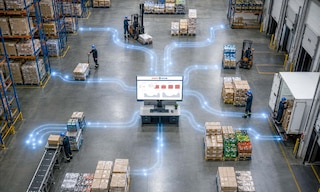
Food traceability: What it is and how to implement it successfully
Food traceability is a fundamental process for companies across the food and beverage industry. Pressure to deliver safe, high-quality products — coupled with consumers’ increasing demand for transparency — has made tighter operational control a business priority. From raw material sourcing to final distribution, the ability to trace food throughout the supply chain supports faster decision-making and boosts efficiency at every stage.
In this post, we explain what food traceability is and examine its different stages. We’ll also look at how to implement it successfully with specialized software.
What is food traceability?
Food traceability is the ability to track a food product and its ingredients throughout the supply chain. It involves recording and managing information generated at every stage, from production and processing through distribution.
Among all forms of product traceability, food requires particularly rigorous oversight because of its direct impact on consumer health. According to the World Health Organization (WHO), 1 in 10 people becomes ill each year after consuming contaminated food. Food traceability helps prevent these situations by enabling regulatory authorities and businesses to respond quickly to incidents, pinpoint the source of the problem, limit its impact, and remove affected products from the market.
International institutions such as the Food and Agriculture Organization of the United Nations (FAO) and the WHO have promoted common frameworks for food safety. One example is the Codex Alimentarius, which establishes globally recognized principles designed to protect consumers and encourage best practices in food trade. As a result, food traceability is now a requirement in most major international markets.
In the US, the Food Safety Modernization Act (FSMA) requires companies handling certain foods to maintain traceability records that support rapid response to potential food safety incidents. Similarly, in the European Union, Regulation (EC) No. 178/2002 mandates that food businesses identify both the origin and destination of products at every stage of the supply chain.
Types of food traceability
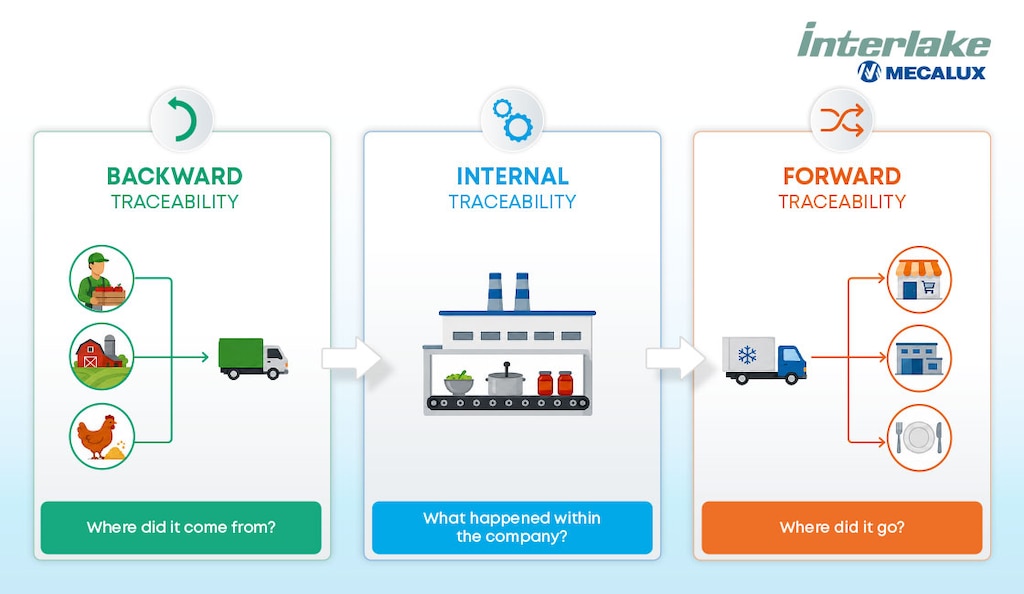
Understanding the different types of traceability in the food industry helps businesses enhance visibility across the supply chain and take quick action when issues arise. Depending on the stage being monitored, food traceability falls into three categories:
Backward traceability (upstream)
This phase identifies the origin of a food product and its ingredients. Its purpose is to determine where each item comes from, along with all relevant information about its sourcing, condition, and receipt.
To accomplish this, companies record details such as the supplier, geographic origin, purchasing information, lot number, food type, and receipt date. This level of traceability also captures the product’s initial processing history.
Internal traceability (process traceability)
This stage covers what takes place within a company’s facility, from receiving raw materials to producing the finished good. It documents any changes food undergoes, such as being portioned, blended, or otherwise transformed.
When properly implemented, internal traceability provides greater visibility into production. It helps detect risks such as cross contamination and improves inventory accuracy.
Forward traceability (downstream)
This category focuses on a product’s journey after its dispatch from the facility. It makes it possible to pinpoint which customers or destinations received each shipment, whether distributors, retailers, or food service businesses.
To support this process, companies maintain records on the shipped product, recipient, shipping date, lot number, previous warehouse location, and transportation conditions. This level of control is particularly valuable when managing food and beverage recalls efficiently.
Key food traceability terms
Managing food traceability involves several important concepts:
- Hazard analysis and critical control points (HACCP): Preventive system used throughout the industry to manage potential food safety hazards. Companies may rely on physical, chemical, microbiological, and sensory analyses of raw materials and finished goods. HACCP is widely adopted and regulated, although specific requirements vary by country, food type, and business activity.
- Blockchain: Technology that securely documents and shares information among supply chain stakeholders through a network of connected computers (nodes) that collectively store and validate data.
- Cold chain: Series of processes that keep food at the required temperature from production through consumption. It helps preserve quality and prevent spoilage.
- Expiration date: Specifies the last date a food product can be consumed safely. After that limit, it may pose a health risk.
- Best-by date: Indicates how long food is expected to retain its intended quality (flavor, texture, and aroma). After that date, it may still be safe to consume if stored properly.
- GS1-128: Barcode standard used on logistics labels to encode information such as lot numbers, expiration dates, and item identification. GS1-128 labels strengthen food traceability.
- Lot number: Code that designates a group of goods manufactured or processed under the same conditions, making it possible to trace them throughout the supply chain.
- Critical control point (CCP): Stage in food production where controls are applied to prevent, eliminate, or reduce potential food safety hazards. CCPs are commonly established during the receiving, storage, handling, preparation, cooking, and transportation phases.
- Traceability record: Collection of data documenting a good’s journey from its origin to its final destination.
- Product recall: Process of removing food items from the market because they pose a health risk or fail to meet quality standards.
- RFID: Radiofrequency technology that uses radio waves to identify goods automatically without direct contact or manual scanning. When integrated with RF scanners, RFID captures real-time data on lots, strengthening food traceability and safety during storage, order fulfillment, and shipping operations.
Implementing a food traceability system
The first step in implementing a food traceability system is to evaluate how goods are tracked and how information is logged throughout the operation. This assessment confirms whether the company can accurately determine each product’s journey from start to finish and retrieve data if a food safety issue arises.
Next, businesses should define the scope of their traceability system across its three dimensions: backward, internal, and forward. For example, food manufacturers that source ingredients from multiple suppliers should place greater emphasis on upstream traceability to trace the origin of raw materials. By contrast, companies distributing food products to other organizations should prioritize downstream traceability to document the destination of every shipped lot. In every case, maintaining clear communication with suppliers, customers, and logistics providers is essential to support information sharing throughout the supply chain.
Implementation also involves determining which data will be collected at each stage, e.g., lot numbers, receipt and shipping dates, storage conditions, and any processing the product undergoes.
More and more companies are adopting digital systems that automate data capture to enhance food traceability. Specialized software accessible from multiple devices makes it easier to consult information in real time while improving product visibility. Technologies such as RFID also represent a major advancement in automatic item identification. These solutions can be deployed in facilities of all kinds, from manually operated warehouses to fully automated distribution centers.
Food traceability software
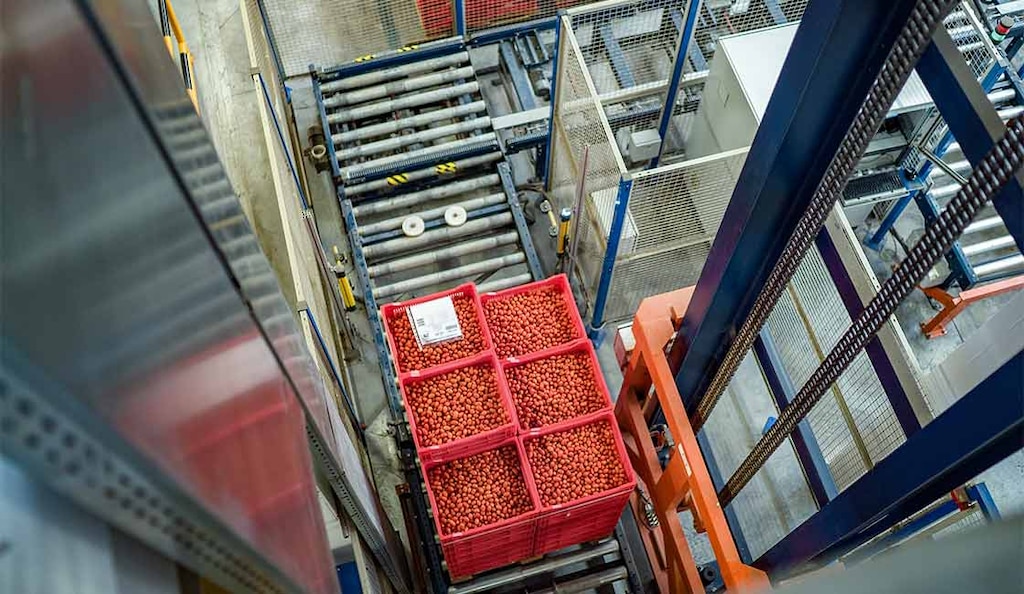
Successful food traceability relies on integration with ERP, manufacturing, warehouse management, and transportation systems. Each of these platforms captures part of the information needed to reconstruct a product’s journey.
Among these solutions, a warehouse management system plays a particularly critical role in internal traceability. This software monitors everything that happens to goods within a facility, spanning receiving, storage, inventory movements, order fulfillment, and shipping. It streamlines data capture through automatic identification technologies such as EAN-13 barcodes, RF devices, and RFID systems.
With Interlake Mecalux’s Easy WMS, for example, businesses can strengthen food traceability by maintaining detailed records of inventory movements, storage locations, and warehouse operations. The system also validates GS1-128 barcodes to verify accurate lot identification, generates reports, and flags potential errors. In addition, it integrates with ERP software to exchange information such as shipping dates and relevant documents.
In manufacturing environments, Easy WMS also supports food traceability through its WMS for Manufacturing module. This solution manages the information associated with every ingredient while coordinating replenishment to production lines. It provides end-to-end visibility into operations at every stage of the manufacturing process.
Examples of food traceability in action
A growing number of food companies rely on solutions such as Easy WMS to automate warehouse operations and optimize product traceability:
- Congelados de Navarra (Spain). This frozen vegetable manufacturer uses Easy WMS to oversee the movement of 160,000 pallets across four automated warehouses. The system tracks each item’s location, status, lot number, and expiration date. It enables precise inventory monitoring, even in environments operating at -13 °F.
- Rica Group (Dominican Republic). Easy WMS maintains traceability for 10,200 pallets of dairy products and juices. The software is synchronized with both the production and ERP systems to identify finished goods automatically. It also applies the FEFO (first expired, first out) strategy, prioritizing shipments with the earliest expiration dates to strengthen food safety.
- Lantmännen Unibake (Poland). Mecalux software monitors refrigerated and frozen goods for this commercial bakery. Integrated with the production system, it logs inventory movements between different warehouse areas. The facility features separate refrigerated and freezer zones to preserve products under the appropriate storage conditions.
- Gusto (France). Digitalization enables this distributor of gourmet foods from Italy, France, and other countries to trace more than 2,000 SKUs supplied to restaurants across France. Easy WMS manages lot numbers, storage locations, and inventory movements. This includes goods sold by weight, such as deli meat.
- Productos Carey (Mexico). The company has reinforced traceability for chili peppers, vegetables, beans, and corn with Easy WMS. The software registers inventory movements, lot numbers, storage locations, and SKUs in real time, from receiving through shipping. With this upgrade, the business is better prepared for internal inspections and external audits.
Technology and traceability
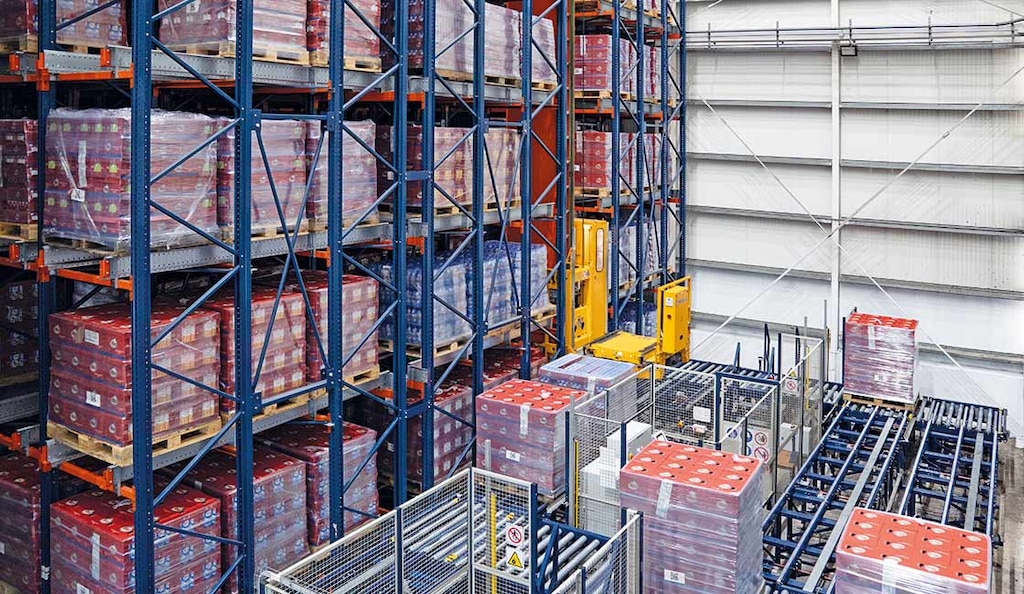
Food traceability is essential for protecting consumers and improving supply chain performance. To comply with applicable regulations, companies need fast, real-time access to information about their products at all stages. Digitalization, supported by a dedicated warehouse management system, minimizes errors and provides complete visibility into every inventory movement. In an increasingly global marketplace, a robust traceability solution helps safeguard consumers while streamlining day-to-day warehouse operations.
FAQ: Food traceability in 5 questions
What is meant by food traceability?
Food traceability is the ability to track a food product and its ingredients throughout the supply chain, from its origin to the end consumer. It involves recording information about lot numbers, goods movements, storage, and distribution to support food safety, manage incidents, and facilitate recalls.
Why is food traceability important?
Food traceability plays a vital role in protecting food safety throughout the supply chain. By logging and overseeing goods and lot numbers, businesses can detect issues quickly, remove affected products from the market, and maintain greater control over quality, storage, and distribution.
What are the different types of food traceability?
There are three main types of food traceability. Backward (upstream) traceability identifies the origin of food products and ingredients. Internal traceability tracks goods movements and processing within a company’s facility. And forward (downstream) traceability determines where each item has been shipped.
Is food traceability a legal requirement?
Yes, food traceability is mandatory in most major international markets, including the US and the European Union. Food businesses must be able to determine both the origin and destination of products at every stage of the supply chain to support food safety and respond rapidly to incidents or recalls.
How is blockchain used in food traceability?
Blockchain technology records and shares food traceability data securely and in a tamper-resistant format among all supply chain actors. When integrated with QR codes or other identification systems, it allows businesses and consumers to verify information (e.g., a product’s origin, lot number, and logistics history) with greater transparency.