



Predictive logistics: What it is and how to implement it
Predictive logistics uses data and advanced technologies to foresee future supply chain events. It helps companies make better use of resources, lower costs, prevent inventory issues, and boost operational efficiency. In this post, we explore what predictive logistics is, how it works, and its main applications in logistics and supply chain management.
What is predictive logistics?
Predictive logistics is a data-driven strategy that anticipates events across the supply chain to optimize decision-making and operational performance.
It combines historical records, real-time data, and advanced analytics with AI and machine learning algorithms. These technologies uncover patterns and trends that can signal shifts in demand, transportation disruptions, replenishment needs, and potential logistics equipment failures.
Predictive logistics vs. traditional logistics
The main difference between predictive and traditional logistics lies in how decisions are made.
Traditional logistics typically responds to situations after they occur. Decisions are based largely on supply chain managers’ experience, limited historical data, and addressing disruptions as they arise.
Predictive logistics, by contrast, draws on large volumes of data and advanced analytics to identify patterns and foresee future scenarios. This approach helps businesses spot potential risks, prevent problems, and improve processes before operations are affected.
While traditional logistics reacts, predictive logistics stays a step ahead.
Why is predictive logistics important today?
Supply chains are becoming increasingly complex. Globalized markets, economic volatility, disruptions to international transportation, ecommerce growth, and rising expectations for quick deliveries have placed greater pressure on logistics operations.
Against this backdrop, managing logistics by responding to events only after they happen is becoming less cost-effective. Organizations must be able to anticipate demand fluctuations and operational disruptions. Predictive logistics turns data into actionable insights, enabling faster, more accurate decisions.
The ability to foresee what may happen has become a competitive differentiator, helping businesses strengthen supply chain resilience and provide better customer service.
Predictive logistics use cases in the supply chain
Predictive logistics can be applied across virtually every stage of the supply chain. From demand planning to equipment maintenance, its capabilities streamline processes while supporting operational efficiency and more informed strategic decision-making.
Demand forecasting
Demand forecasting is one of the most widespread applications of predictive logistics. By analyzing historical sales data, market trends, consumer behavior, and external factors, companies can anticipate spikes or drops in demand more accurately.
This capability helps organizations forecast future sales to plan purchasing and production, prepare for seasonal fluctuations, detect shifts in consumption patterns, and align operational capacity with actual business needs. More accurate estimates of shipment volumes also allow for more efficient allocation of transportation and distribution resources.
Predictive inventory management
Inventory management is another area where predictive logistics has a significant impact. Predictive models help companies avoid two of the most common challenges facing any warehouse: stockouts and overstock.
Using demand forecasts, organizations can determine when to replenish goods, how much inventory to hold, and where to position it across the logistics network. This helps maintain optimal stock levels, accelerate inventory turnover, and reduce tied-up capital. The result is greater product availability with lower storage costs.
Transportation route optimization
Predictive algorithms analyze multiple variables to plan more efficient transportation routes. Factors include traffic conditions, road incidents, weather, driving restrictions, and carrier availability.
Based on this information, systems select the fastest, most cost-effective route for each shipment. This approach shortens delivery times while reducing expenses for fuel, vehicle maintenance, and driving hours. Predictive route optimization also leads to more punctual deliveries and smarter use of transportation resources.
Predictive maintenance for logistics equipment
Predictive logistics can also support the management of warehouse machinery and assets. With IoT sensors and continuous monitoring systems, companies can spot early signs of wear or anomalies in equipment such as forklifts, conveyors, sorters, and automated storage and retrieval systems (AS/RS). Predictive models analyze these data to identify potential failures before breakdowns occur.
Early anomaly detection helps prevent unplanned downtime, extend equipment service life, and lower maintenance costs. To keep warehouses performing at their best over time, businesses can also rely on specialized lifecycle management services for logistics equipment.
Improving the customer experience
The ability to anticipate events also directly impacts customer satisfaction. With predictive logistics, delivery times become more reliable and delays are minimized, creating a more predictable purchasing experience without unwelcome surprises.
It also helps organizations identify potential disruptions early and take corrective action before they affect end customers. As a result, businesses can better meet their delivery commitments, build trust, and strengthen customer relationships.

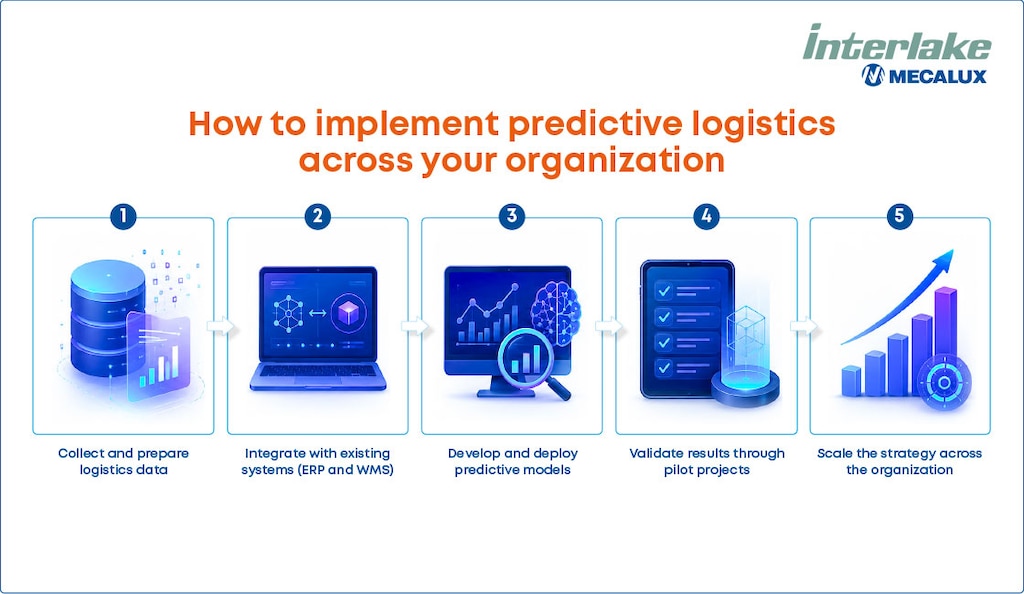
How to implement predictive logistics in a company
Predictive logistics can be introduced in phases, starting with high-impact areas such as inventory management or demand forecasting. To realize its full potential, organizations need reliable data, the right technology, and a well-defined implementation strategy.
Collect and prepare logistics data
The quality of predictions depends directly on the data behind them. The first step is to collect, centralize, and clean information from different areas of the supply chain, including sales, inventory, transportation, purchasing, and production.
Accurate, consistent, and up-to-date data make it possible to uncover patterns and build more reliable predictive models. Without a solid data foundation, even the most advanced algorithms will deliver limited results.
Integrate with existing systems (ERP and WMS)
Predictive tools need to integrate with a business’s existing management solutions. Connecting them with an ERP and a warehouse management system (WMS) — such as Interlake Mecalux’s Easy WMS — enables a continuous flow of information and gives predictive models access to up-to-date, real-time data.
Through this integration, companies can also directly incorporate recommendations and forecasts generated by the algorithms into day-to-day operations.
Train and deploy predictive models
Once the necessary data and integrations are in place, AI and machine learning algorithms can begin analyzing the information.
These models spot patterns and trends in the data to forecast demand, replenishment requirements, operational disruptions, and potential bottlenecks. As new information becomes available, they continue learning and producing increasingly reliable predictions.
Validate results through pilot projects
Before rolling out predictive logistics across the organization, businesses should conduct proofs of concept in specific areas of the supply chain. These pilot projects allow companies to assess system performance, measure forecast accuracy, and identify areas for improvement.
Early validation makes it easier to fine-tune the models and minimize risks during implementation.
Scale the strategy across the organization
Once the pilot project has proven effective, the next step is to gradually expand implementation to other processes, logistics facilities, or business areas.
The goal is to extend predictive capabilities across the supply chain to optimize planning, streamline resource use, and facilitate faster, data-driven decision-making. As the strategy expands, so does its potential impact on operational efficiency and the company’s competitiveness.
Predictive logistics: A competitive advantage for the supply chain
Predictive logistics enables businesses to turn large datasets into more accurate, proactive decisions. Amid market volatility and increasingly complex supply chains, predictive capabilities have become essential to boosting efficiency, cutting costs, and delivering better customer service. Here are some of the key takeaways on predictive logistics:
- Predictive logistics anticipates future supply chain events allowing organizations to act before disruptions occur.
- Implementation should begin in high-impact areas, such as demand forecasting or inventory management.
- Data quality, availability, and integration are crucial for generating reliable predictions that support decision-making.
- Connecting predictive tools with ERP and WMS software makes it easier to put forecasts into practice in daily operations.
- Companies should validate models through pilot projects before expanding the strategy across the organization.
- Predictive logistics helps lower costs, improve service levels, and strengthen supply chain resilience in the face of change and unexpected events.
Predictive logistics FAQs
What is predictive logistics?
Predictive logistics is a strategy that uses historical data, AI, and analytical models to anticipate future supply chain events. It helps businesses forecast demand, fine-tune inventory management, prevent operational disruptions, and make faster decisions before problems arise.
What’s the difference between prescriptive and predictive logistics?
Predictive logistics forecasts what may happen based on data analysis. Prescriptive logistics goes a step further: In addition to predicting possible scenarios, it recommends the best course of action to achieve a specific goal, such as cutting costs, streamlining routes, or enhancing service.
What’s the difference between predictive logistics and predictive analytics?
Predictive analytics is a broad discipline that uses data and algorithms to estimate future outcomes across different fields. Predictive logistics applies these capabilities specifically to the supply chain, helping businesses forecast demand, manage inventory, and optimize logistics operations.
What technologies are required for implementing predictive logistics?
Predictive logistics relies on technologies such as AI, machine learning, the Internet of Things (IoT), big data, and logistics management systems. These tools collect, process, and analyze large volumes of information to generate reliable, actionable forecasts.
What types of companies can benefit from predictive logistics?
Any organization with logistics operations can benefit from predictive logistics. It’s particularly valuable for manufacturers, distributors, logistics providers, and ecommerce companies that manage large inventories, numerous SKUs, or complex supply chains.