


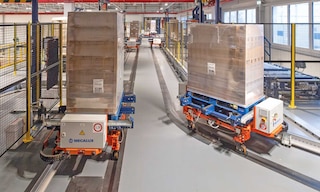
Rail guided vehicle in the warehouse: What it is and when to install one
A rail guided vehicle (RGV) is an increasingly common solution for automating the internal movement of goods in industrial facilities. As companies seek to accelerate pallet flow between different areas of their warehouses, this technology has become a reliable way to connect logistics processes efficiently and maintain a steady flow of materials.
In this post, we explain what a rail guided vehicle is and how it works. We’ll also explore its main features, advantages and limitations, and when installing one makes sense.
What is a rail guided vehicle for pallet handling?
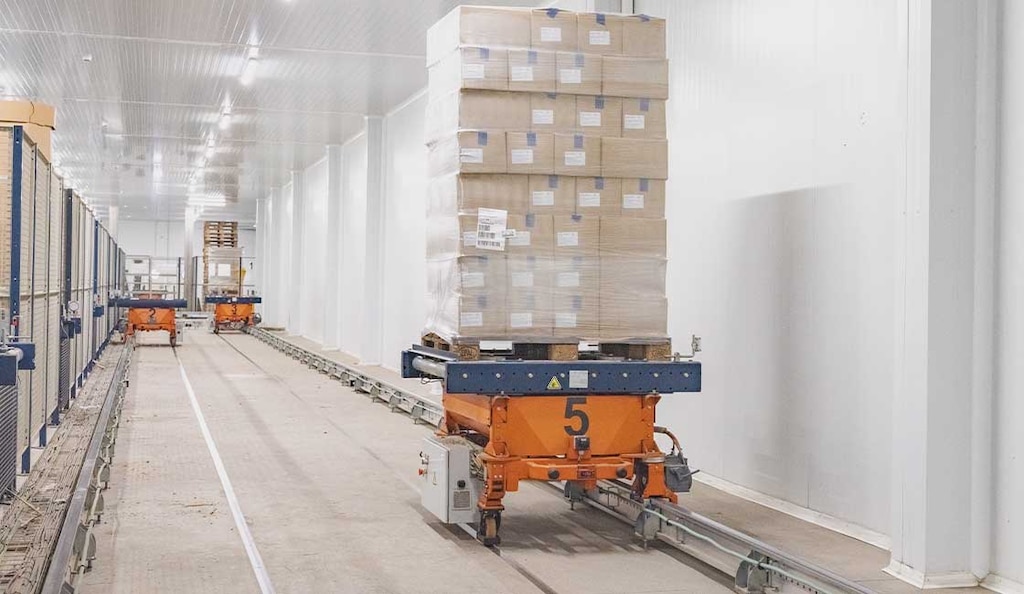
A rail guided vehicle (RGV) is an automated device that travels along rails to transport goods within a warehouse. In logistics automation, these machines are also called rail guided transfer carts or, less often, rail guided shuttles.
Rail guided vehicles are used in facilities that need to move large volumes of pallets between designated areas. One or more transfer cars travel along rails on a predefined route, stopping at specific pickup and drop-off points. Because they run on fixed infrastructure and repeat the same movements, rail guided vehicles are particularly well suited to connecting warehouse zones with a high, continuous flow of goods.
Unlike pallet conveyors, which transport loads continuously along a fixed path, a rail guided vehicle carries pallets between multiple pickup and delivery points along its rail network. Automated guided vehicles (AGVs) and laser-guided vehicles (LGVs), by comparison, travel through a facility without requiring rails, following predefined routes. Meanwhile, autonomous mobile robots (AMRs) can calculate and adjust their paths in real time, giving them greater routing flexibility.
Systems such as the Pallet Shuttle and 4-Way Pallet Shuttle serve a different purpose. They automate pallet storage and retrieval within the racking, while a rail guided vehicle handles in-house transport between separate areas of a warehouse.
How rail guided vehicles work
A rail guided vehicle system consists of one or more automated carts that travel on rails to move pallets between different points in a facility. Each vehicle receives instructions from the warehouse control system, picks up a load at its point of origin, and delivers it to the assigned destination. This makes it possible to link areas such as storage, production, picking, and shipping.
Depending on the application, rail guided vehicles can carry loads of up to 3,300 lb and reach speeds of up to 985'/min (16.5'/s). The carts are typically outfitted with a roller or chain conveyor, or forks, for automatic load transfer. They can integrate with equipment such as conveyors, pallet elevators, or stacker cranes.
The warehouse management system (WMS) oversees inventory and determines which goods need to be transferred. The warehouse execution system (WES) coordinates and prioritizes internal transport orders throughout the facility, while the warehouse control system (WCS) converts those instructions into commands for the automated equipment and supervises its operation.
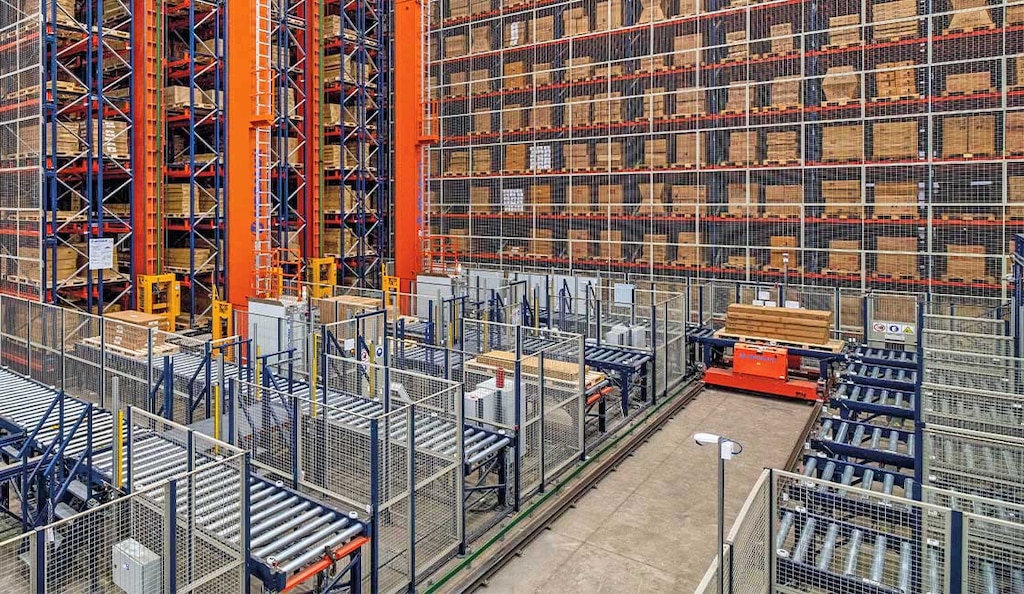
Rail guided vehicles generally run on linear tracks or closed-loop circuits. However, they can also be configured for more complex layouts with multiple pickup and drop-off points. System safety features can include LiDAR laser scanners, anti-collision sensors, emergency stops, and wire mesh partitions to safeguard personnel and load transport.
Benefits of rail guided vehicles
Installing a rail guided vehicle system can offer several advantages in facilities with high volumes of in-house pallet traffic:
- High throughput on repetitive routes. Rail travel supports high speeds and a steady pallet flow between fixed points.
- Robust load-handling capacity. RGVs can carry heavy pallets and complete a large number of transfers across medium- and long-distance routes.
- Predictable, controlled traffic. Because each vehicle follows a fixed path, its movements are easy to coordinate and don’t interfere with equipment operating outside the rail circuit.
- Scalable carrying capacity. Multiple vehicles can operate on the same track, meaning the system can accommodate greater demand as requirements change.
- Integration with multiple transfer points. A single system can serve conveyors, elevators, stacker cranes, and other warehouse areas.
These characteristics make rail guided vehicles particularly effective where high, consistent volumes move between fixed locations. More flexible technologies, such as AGVs, may be better suited to facilities where routes change frequently.
Despite their benefits, transfer carts also have some limitations that should be considered before implementation:
- Fixed infrastructure requirements. Installing rails involves a higher initial investment and can place constraints on warehouse design.
- Less flexibility than AMRs. Changing routes or extending the circuit generally calls for modifications to the infrastructure.
- Best for stable material flows. Rail guided vehicles perform most effectively when transfers between areas are repetitive and predictable. If operating patterns change frequently, more flexible technologies such as AMRs may be a better fit.
For this reason, it’s important to assess your warehouse processes, pallet flow volumes, and future expansion needs before selecting the most appropriate solution.
When to install a rail guided vehicle
A rail guided vehicle is an optimal solution when large numbers of pallets need to be transferred automatically between fixed areas of a facility. This solution is especially effective in warehouses with repetitive, predictable flows where throughput and dependable internal transport are critical. Common applications include:
- Sequencing pallets before shipping, arranging them by carrier route, order, or dispatch priority.
- Connecting multiple warehouse areas through a system with several pickup and drop-off points where loads move continuously at high volumes.
- Supplying areas that require pallets in a specific sequence, such as shipping zones or certain production processes.
- Handling heavy traffic along fixed routes, particularly when a single circuit can serve several transfer points.
In these applications, a pallet rail guided vehicle system automates in-house material transport, streamlines goods flows, and can connect with other automated equipment and WMS software.
Examples of warehouses using rail guided vehicles
Rail guided vehicles are utilized in facilities across a range of industries to automate internal pallet transfer and improve material flow. One widespread application is shipment sequencing. At the warehouse of medical and respiratory products manufacturer Intersurgical in Lithuania, two rail guided vehicles automatically organize pallets in flow storage lanes according to order or distribution route, speeding up load consolidation before shipping.
Nupik Internacional uses a similar setup in its facility. A rail guided transfer cart sorts goods into 24 preload lanes as directed by Mecalux’s Easy WMS, grouping orders by route, customer, or vehicle.
Another frequent application is picking area replenishment. At Bathroom Mountain’s UK warehouse, a rail guided vehicle distributes high-turnover products directly to goods-to-person pick stations. Brazilian cooperative Copacol, meanwhile, uses rail guided vehicles to continuously feed carton flow picking lanes in a refrigerated and frozen facility. This system keeps products available and supports the fulfillment of around 400 orders a day.
Rail guided vehicle: A solution for automating in-house pallet transport
Rail guided vehicles automate pallet transfer between different warehouse areas with speed and precision. Although their suitability depends on each facility’s processes and objectives, they’re especially effective in operations with repetitive routes and high pallet flow volumes. Key takeaways include:
- Install rail guided vehicles on fixed, repetitive routes when pallets need to move automatically between different warehouse zones.
- Prioritize them in operations with high, consistent flows, where throughput and reliability are critical.
- Integrate rail guided vehicles with your warehouse management system to coordinate pallet movement with conveyors, stacker cranes, elevators, and related automated processes.
- Compare RGVs with AGVs and AMRs based on route stability. Rail guided vehicles are particularly well suited to paths that are clearly defined and rarely need to change.
- Analyze your warehouse layout, material flows, and future expansion needs before implementation to size the solution correctly and allow for growth.
Rail guided vehicles: 5 FAQs
What’s the difference between an AMR, AGV, LGV, and RGV?
The main difference lies in how each vehicle is guided. RGVs travel exclusively on rails and are designed for fixed routes with high throughput. AGVs and LGVs move across the warehouse floor using different guidance technologies, while AMRs navigate autonomously, adjusting their paths in real time based on their surroundings.
What’s the difference between a pallet conveyor and an RGV?
Pallet conveyors move loads continuously along a set path using rollers, chains, or other conveying elements. A rail guided vehicle, by contrast, is a robotic cart that travels between various points of a fixed route rather than forming part of a continuous transport stream. In many projects, RGVs connect directly with conveyors for pallet loading and unloading.
When should you install a rail guided vehicle?
A rail guided vehicle is recommended when pallets need to move repeatedly between fixed warehouse areas such as production, storage, and shipping. In these applications, an RGV can automate internal transport, shorten travel times, and raise overall facility productivity.
How does a rail guided vehicle integrate with a WMS?
The WMS determines the warehouse destination of each pallet, while the WCS or WES converts those instructions into internal transport missions for the rail guided vehicles. This integration coordinates automated equipment across the facility, supporting a continuous flow of goods.
Which companies provide rail guided vehicle solutions?
Interlake Mecalux develops rail guided vehicle solutions as part of its warehouse automation portfolio. For each project, we analyze clients’ in-house flows and operational goals to determine whether an RGV, conveyor, AMR, or another technology is the best fit.