


What is Industrial IoT (IIoT)? Architecture, applications, and examples
The Industrial Internet of Things (IIoT) is transforming how factories and warehouses manage their operations. By connecting machines, sensors, equipment, and software systems, companies can collect and analyze data in real time to improve efficiency, automate processes, and make better decisions.
In this article, we explore what Industrial IoT is, how it works, its applications and benefits, and its role in modern warehouses.
What is Industrial IoT (IIoT)?
Industrial Internet of Things (IIoT) is a network of interconnected machines and systems that exchange information in real time to optimize operations in production facilities and warehouses. IIoT enables stacker cranes, conveyors, sensors, PLCs, and software systems to share data on facility conditions, inventory movements, and process performance. As a result, each piece of equipment no longer operates in isolation but coordinates its actions with the others.
IIoT represents an evolution of the Internet of Things (IoT) adapted to the specific needs of industry. Advances in communications technology, the growing use of increasingly precise sensors, and systems capable of processing large volumes of data have made it possible to extend this model to warehouses and factories, where coordination is essential for keeping operations running smoothly.
IIoT vs. IoT: What is the difference?
The Industrial Internet of Things (IIoT) and the Internet of Things (IoT) share the same technological foundation: connecting devices to exchange data. However, they address different needs. IIoT is designed to coordinate critical industrial processes, while IoT focuses on consumer applications and everyday use.
This table summarizes the main differences between Industrial IoT and IoT:
| Industrial Internet of Things (IIoT) | Internet of Things (IoT) | |
|---|---|---|
| Purpose | Optimize industrial processes and automate operations |
Improve user convenience, connectivity, and experience |
| Users |
Companies, operators, engineers, and production managers |
Individuals and households |
| Devices |
Industrial sensors, PLCs, robots, stacker cranes, AMRs, AGVs, and conveyors |
Smartwatches, voice assistants, thermostats, cameras, and home appliances |
| Criticality |
Very high: a failure can halt production |
Low to medium: a failure generally affects the user experience |
| Availability |
Operates 24/7 |
Depends on usage |
| Security |
Top priority: protects processes and infrastructure |
Focuses on data protection and privacy |
| Latency |
Very low: responses must be almost immediate |
Less demanding |
| Precision |
High, to ensure reliable operations |
Varies by device |
| Scalability |
Integrates thousands of industrial devices and systems |
Connects numerous devices to cloud platforms |
| Examples |
Automated warehouses, production lines, and distribution centers |
Smart homes, wearables, and connected lights |
How does Industrial IoT work?
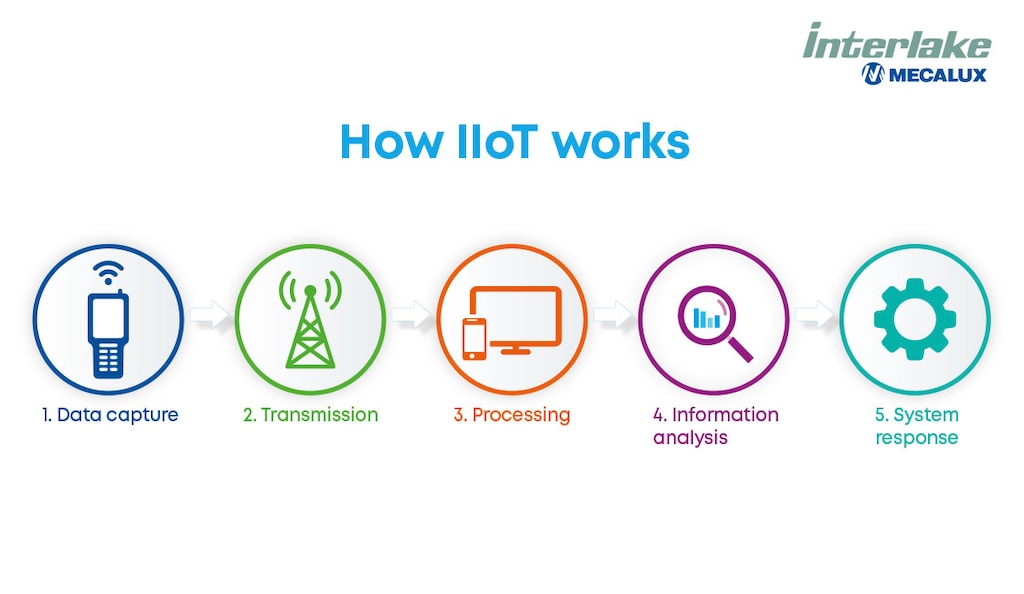
Industrial IoT operates through a continuous flow of information that connects industrial equipment with the systems used to monitor and optimize operations.
First, sensors installed on machines — such as stacker cranes, conveyors, or autonomous mobile robots (AMRs) — collect data on inventory locations, equipment status, and operating conditions. This information is transmitted over the network and can be processed either in the cloud or close to its source (through edge computing), depending on the requirements of each application.
The data is then sent to an Industrial IoT platform and integrated with various applications. In an automated facility, solutions such as the Easy WMS warehouse management system, WES (warehouse execution system), and WCS (warehouse control system) use this information to coordinate equipment, manage inventory flows, and synchronize operations in real time. Lastly, analysis of this data can trigger alerts, generate recommendations, or prompt system responses.
Components of an Industrial IoT system
An industrial IoT architecture brings together various technologies to connect physical operations with management systems. In a production facility or warehouse, sensors collect data about equipment status and inventory movements, while actuators execute commands on machinery. PLCs in automation — devices that control how machines operate — receive this information and use it to coordinate equipment. Meanwhile, SCADA (supervisory control and data acquisition) systems monitor the facility in real time and display the status of all processes through a single interface.
Information from all components is transmitted through industrial networks and gateways to Industrial IoT platforms. These systems centralize data from connected devices and provide tools to monitor, analyze, and manage it. An Industrial IoT solution combines the platform with sensors, communications networks, and software applications to meet the needs of each facility. The information collected can then be processed in the cloud or through edge computing.
From there, applications such as ERP, MES (manufacturing execution system), and WMS software leverage the data to plan resources, coordinate production, and manage warehouse operations. Finally, advanced analytics and AI identify patterns, anticipate issues, and support decision-making.
Industrial IoT applications and examples
Industrial IoT has applications across numerous industries, where it connects machines, equipment, and systems to exchange data in real time and optimize operations. Here are some examples:
- Manufacturing. In production facilities, Industrial IoT helps monitor machine status, automate processes, and perform predictive maintenance to reduce downtime and improve productivity.
- Logistics and warehousing. Industrial IoT supports the digitalization of warehouses and distribution centers by connecting equipment and systems. One example is British Sugar. As part of its strategy to modernize and digitalize operations, the business installed a Mecalux automated storage system at its Wissington plant.
- Energy. Energy companies use IIoT to monitor generation and distribution facilities, reduce energy consumption, and anticipate maintenance needs.
- Utilities. Water, gas, and electricity providers leverage Industrial IoT to monitor supply networks in real time, detect leaks or failures, and ensure service continuity.
- Transportation. Industrial IoT provides continuous information on vehicles and goods, helping companies streamline routes, enhance traceability, and respond quickly to issues.
Industrial IoT in automated warehouses
Industrial IoT is vital in automated warehouses because it connects equipment, sensors, and systems so they can exchange information and provide a comprehensive overview of operations. This connectivity makes it possible to monitor facility status, inventory movements, and ongoing processes in real time, supporting more effective management.
Multiple sensors collect data on the performance of equipment such as stacker cranes, conveyors, AMRs, and pick stations. This information is then integrated with the WMS, which uses it to monitor operations and ensure inventory traceability. Continuously analyzing Industrial IoT data allows facilities to detect abnormal behavior before a breakdown occurs, laying the foundation for predictive maintenance.
Industrial IoT benefits
Industrial IoT’s ability to collect, exchange, and analyze data in real time delivers multiple advantages for organizations. Its main benefits include:
- Productivity. Continuous process monitoring streamlines operations and supports higher performance. For example, PepsiCo’s automated warehouse in Środa Śląska, Poland, moves around 3,500 pallets a day while maintaining a continuous flow between production and shipping.
- Less downtime. Ongoing monitoring of equipment status helps detect issues before they affect operations, preventing unplanned interruptions.
- Quality. Continuous data collection makes it easier to detect process deviations. At Novartis’s automated warehouse in Stryków, Poland, automation helps preserve pharmaceuticals without handling errors.
- Energy efficiency. IIoT technology helps minimize energy consumption by monitoring equipment and facilities. One example is smart lighting, which adjusts illumination according to activity in each warehouse zone.
- Traceability. Industrial IoT provides real-time visibility into the location and status of goods throughout their journey, simplifying inventory control and reducing errors.
- Safety. Automating certain tasks limits manual intervention and helps create safer work environments.
- Resource optimization. Ongoing access to information about inventory status and warehouse activity helps companies make better use of space and equipment. At Clavo Food Factory, which modernized its plant in Tordesillas, Spain, with Mecalux solutions, continuous inventory monitoring has shortened operating times by 20%.
- Continuous improvement. Every data point collected by Industrial IoT provides an opportunity to enhance processes. Historical analysis also enables businesses to identify trends and implement improvements.
- Predictive maintenance. Rather than waiting for a breakdown to occur, Industrial IoT anticipates potential failures by monitoring variables such as temperature, vibration, and energy consumption.
Challenges of implementing IIoT
Implementing Industrial IoT involves more than installing sensors and connecting machines. The real challenge is ensuring that all components in the ecosystem exchange information reliably and generate useful data for decision-making. Implementation doesn’t have to happen all at once, either. Many organizations adopt Industrial IoT technologies incrementally, integrating them with their existing infrastructure as part of a gradual digital transformation.
One of the main challenges is achieving interoperability between equipment from different manufacturers and integrating legacy systems that weren’t designed to operate in connected environments. Companies also need to ensure stable connectivity, scale their infrastructure without compromising performance, and maintain data quality. Beyond these considerations, they must assess the return on investment (ROI) of each project and support implementation with effective change management. This includes training employees and adjusting work processes.
Industrial IoT security
The convergence of information technology (IT) and operational technology (OT) — together with growing connectivity between machines, sensors, and software — has increased exposure to potential cyberattacks. Protecting these environments is vital for preserving data integrity and ensuring uninterrupted facility operation.
To minimize these risks, businesses combine various cybersecurity measures. Examples include segmenting IT and OT networks, authenticating connected devices, regularly updating firmware, and continuously monitoring systems to detect abnormal behavior. In addition, according to Deloitte, the zero trust model is gaining traction in industrial environments as a strategy for strengthening security. It regularly verifies the identity of users and devices before granting them access to systems.
Industrial IoT, Industry 4.0 and digital transformation
Industrial IoT drives digital transformation and supports the development of smart factories and warehouses. Together with AI, edge computing, cloud computing, and digital twins, it helps create increasingly automated and efficient environments.
Industry 4.0 combines all these technologies to transform how companies manufacture products, store goods, and manage their operations. Industrial IoT plays a key role by connecting people, machines, and software and turning data into useful information.
Industrial IoT: 5 FAQs
What are Industrial IoT solutions?
Industrial IoT solutions integrate sensors, machines, PLCs, communications networks, and software systems so that all equipment in a production facility or warehouse can exchange information in real time. This improves monitoring, automation, and decision-making.
What’s the difference between an Industrial IoT platform and an Industrial IoT solution?
The difference lies in their scope. An Industrial IoT platform provides the tools needed to connect devices and manage the data they generate. An Industrial IoT solution combines that platform with sensors, communications networks, and other systems to address a specific use case, such as automating a warehouse or monitoring a production line.
What devices are used in Industrial IoT?
Industrial IoT devices include sensors, actuators, PLCs, gateways, and automated equipment such as stacker cranes, conveyors, and AMRs. These devices exchange data in real time with Industrial IoT platforms and WMS, WES, and WCS solutions to streamline operations.
What is the difference between Industrial IoT and Industry 4.0?
Industry 4.0 is a digital transformation model that combines technologies such as AI, robotics, edge computing, digital twins, big data, and IIoT to optimize processes. Industrial IoT, meanwhile, connects machines and systems so they can exchange data in real time.
Can existing warehouses be upgraded with Industrial IoT?
Yes. Implementing Industrial IoT doesn’t require building a warehouse from scratch. In many cases, companies can gradually incorporate sensors, connected devices, and software, integrating them with existing infrastructure and systems. The project’s scope will depend on the level of automation and the compatibility of the equipment already in place.