


Parallel picking: What it is, how it works, and when to use it
Parallel picking is a technique that can be integrated with several order picking methods to shorten fulfillment times and improve a facility’s performance. Implementing it successfully requires precise coordination among associates and a warehouse management system to assign tasks and synchronize the entire process.
In this post, we explain what parallel picking is and how it works. We’ll also show you how it relates to other picking methods and when it makes sense to use it.
What is parallel picking?
Parallel picking is a strategy in which a single order is divided into subtasks that can be completed simultaneously. The goal is to shorten the time it takes to prepare an order for shipment and improve warehouse productivity. To achieve this, multiple associates work together on the same order.
Parallel picking shouldn’t be confused with one associate filling several orders at the same time. With parallel picking, each warehouse picker retrieves the items assigned to them based on their location or other criteria, such as product family, priority, or weight. The items are then brought together at a consolidation station, where the team verifies and groups them before packing and shipping. A warehouse management system (WMS) is crucial for this process. It divides the order, assigns tasks to each associate, and coordinates final consolidation.
How does parallel picking work?
For parallel picking to be efficient, several processes must be carefully coordinated:
Dividing the order into several tasks
The process begins by splitting the order into smaller parts that can be picked at the same time. The WMS assigns tasks to associates based on multiple criteria, such as the warehouse area where the items are located, the type of product required, the picking strategies to be used, workload, and shipping priority.
Simultaneous fulfillment
Once the order has been divided, the picking tasks can be carried out in parallel. A WMS can speed up this stage by integrating with pick-to-light, pick-by-voice, RF scanners, and other support systems, including autonomous mobile robots (AMRs). This shortens the total time needed to fulfill the order.
Order consolidation
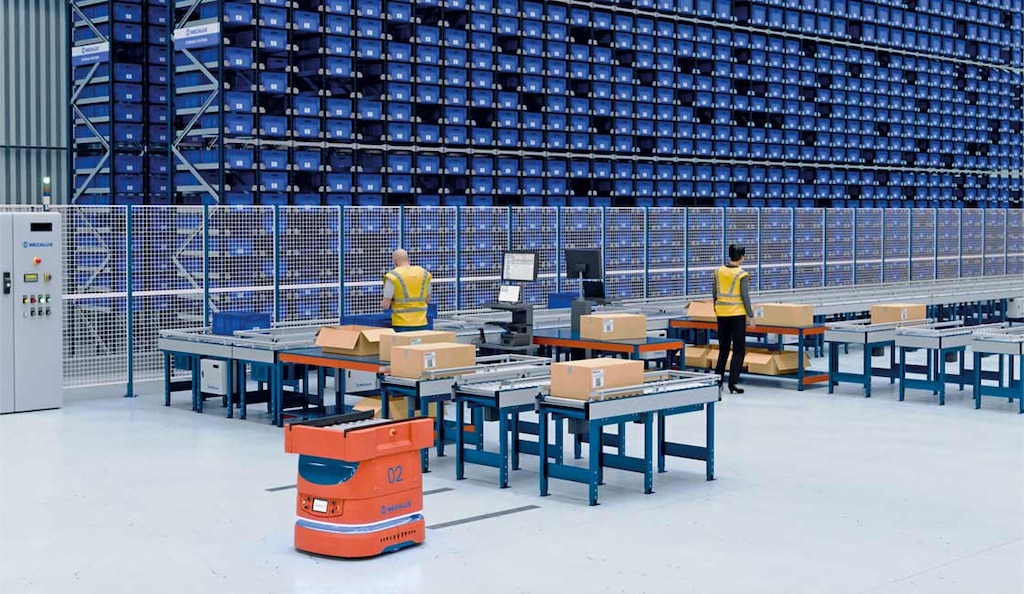
Once all associates confirm that they’ve picked their assigned items, the products are brought together at a consolidation station. There, the team verifies that the order is complete before sending it to packing and, ultimately, shipping. Advanced capabilities — such as those available in Easy WMS — can help carry out this step accurately. Multi-Carrier Shipping Software, for example, automates direct communication between the warehouse and different transportation providers.
Coordination and synchronization
The WMS solution must be able to create picking tasks, track their status, and sync goods consolidation to ensure each order is fulfilled correctly. It should also balance workloads across the various zones, preventing unnecessary delays when some teams finish before others. Interlake Mecalux’s Easy WMS includes the features needed to coordinate this process.
How parallel picking relates to other order picking methods
Rather than replacing other order picking techniques, parallel picking can be combined with them to shorten fulfillment times and increase warehouse productivity.
Parallel picking and discrete picking
With discrete picking, also known as single-order or piece picking, one associate fills an order from start to finish. Although this approach may work well in some facilities, it can be inefficient in large or high-throughput warehouses. In these situations, parallel picking is more effective because it breaks down an order so several people can work on it at the same time.
Parallel picking and batch picking
Batch picking involves completing several orders on a single run to reduce travel time. Parallel picking, on the other hand, divides one order among several associates to speed up fulfillment. The two strategies are perfectly compatible: batch picking streamlines travel routes, while parallel picking shortens the time needed to complete each order.
Parallel picking and wave picking
Wave picking organizes order fulfillment into different time windows, or waves. They’re released according to criteria such as priority, shipping route, or departure time. Within each wave, parallel picking allows multiple associates to work on different parts of an order simultaneously.
Parallel picking and zone picking
Zone picking divides the warehouse into several work areas and assigns each space to one or more associates. Parallel picking can build on this arrangement. In other words, zone picking defines how work is distributed throughout the facility, while parallel picking determines how each order is filled.

Parallel picking pros and cons
Parallel picking can offer companies several advantages, though it also has its challenges.
One major benefit is that it shortens order fulfillment times, boosting productivity. It also helps warehouses handle demand peaks by distributing the workload among multiple associates. By picking different parts of an order at the same time, the facility moves goods through the process faster and can take on more work.
However, implementing this strategy requires changes and can add complexity if not carefully planned. Parallel picking calls for close coordination among associates, a consolidation area for grouping items, and a WMS that assigns tasks, keeps them synchronized, and tracks the status of each order throughout the process.
When is parallel picking the right option?
Parallel picking is recommended for warehouses handling a high volume of orders with multiple SKUs. It can also be useful when orders include items stored in different areas, since it eliminates the need for one picker to travel long distances.
This strategy works best when supported by careful planning and a WMS that coordinates assignments, associate workloads, and goods consolidation. By contrast, parallel picking may be less beneficial in small facilities, where a single picker can efficiently complete orders from start to finish.
Tips for implementing parallel picking
The success of parallel picking depends on the warehouse layout, how tasks are coordinated, and whether the WMS can synchronize the entire process.
- Design picking zones effectively. A well-planned warehouse layout prevents some areas from carrying a heavier workload than others and helps maintain a steady pace.
- Minimize consolidation times. Bringing items together quickly helps avoid unnecessary delays and bottlenecks.
- Monitor performance. Analyzing cycle times, productivity, and error rates makes it easier to spot opportunities for improvement.
- Automate coordination. A WMS assigns tasks, syncs associates’ work, and organizes order consolidation.
WMS: An essential tool for parallel picking
Ultimately, parallel picking can make order fulfillment more efficient. But it must be used in the right setting and supported by systems capable of coordinating the work. Before introducing this strategy:
- Evaluate whether your order volumes and warehouse layout justify implementing parallel picking.
- Adapt the picking strategy to the specific needs of your business and customers.
- Implement a WMS to coordinate order picking and consolidation.