


High-density storage systems: Types, advantages, and how to choose the right solution
High-density storage systems address a common logistics challenge: expanding capacity without increasing the facility’s footprint. Rising industrial real estate costs and the need to accommodate growth without building new warehouses are driving demand for solutions that leverage every square foot and fit more storage locations into less space.
In this post, we explore what a high-density storage system is, its main advantages and limitations, and the different solutions available for handling palletized loads.
What is a high-density storage system?
A high-density storage system is designed to concentrate more inventory in less space. It makes better use of the available floor area — with fewer or no working aisles — and leverages vertical space with high-bay or automated solutions. Unlike selective pallet racking, which provides direct access to every unit, high-density storage systems store several loads deep to maximize the available footprint.
Goods can be managed according to three main inventory rotation strategies: FIFO (first in, first out), LIFO (last in, first out), and FEFO (first expired, first out). The appropriate method depends on factors such as product shelf life and stock turnover.
High-density pallet storage is one of the main ways to make better use of available warehouse space. However, the same principle can be applied to other load types and operations, with solutions such as carton flow racks, multi-tier shelving, and the Shuttle System, a compact solution designed to automate box storage.
Advantages and limitations of high-density storage
Warehouse design requires balancing three key factors: storage density, goods accessibility, and productivity. Greater density increases capacity, but some systems restrict direct access to certain loads. As a result, no single solution is suitable for every facility.
Advantages:
- Better use of space: Fewer aisles allow a larger share of the available floor area to be dedicated to storage.
- Increased capacity: Higher density makes it possible to accommodate more goods within the same facility.
- Lower cost per pallet stored: Greater density helps companies get more value from the space available.
- Reduced energy consumption in cold storage: High-density configurations decrease the volume kept at a controlled temperature, helping limit energy use.
- Greater efficiency with large quantities per SKU: Grouping numerous pallets of the same SKU simplifies the handling of large product batches.
Limitations:
- Less direct access to goods: With the exception of mobile pallet racking, high-density systems do not provide individual access to every unit stored.
- Need for FIFO or LIFO strategies: Product characteristics, warehouse layout design, and entry and exit points determine the order in which loads are handled.
- Less flexibility with a wide range of SKUs: Some systems become less efficient when only a small number of units are stored for each SKU.
Types of high-density storage systems
High-density storage systems can be classified according to several criteria, including their level of automation: manual, semi-automated, or fully automated.
Manual high-density storage systems
Manual high-density storage systems offer an effective way to increase capacity without automated handling equipment. Depending on the solution, forklifts either enter the storage lanes or handle pallets from the aisles in front of the racks.
Drive-in/drive-through pallet racks
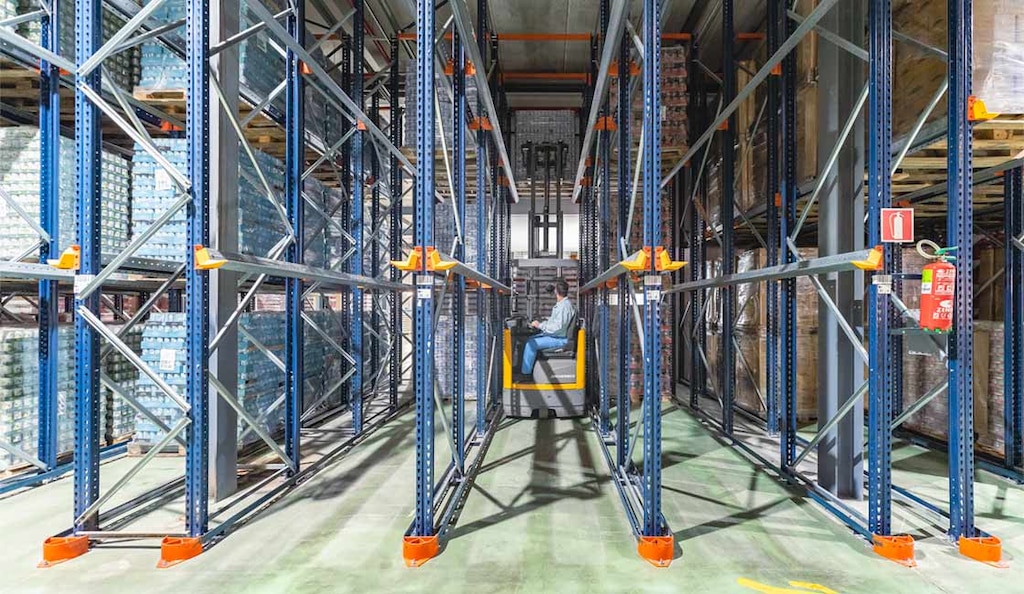
High-density drive-in/drive-through racking consists of deep storage lanes with rails that support the pallets. Forklifts enter the structure to load and retrieve goods.
In the drive-in configuration, pallets enter and leave from the same side, so it generally follows the LIFO principle. Drive-through racking is loaded and unloaded from opposite ends, enabling FIFO stock rotation.
This solution is particularly well suited to homogeneous goods — with many units per SKU — when the priority is to achieve high storage density with a relatively low investment.
Push-back racks
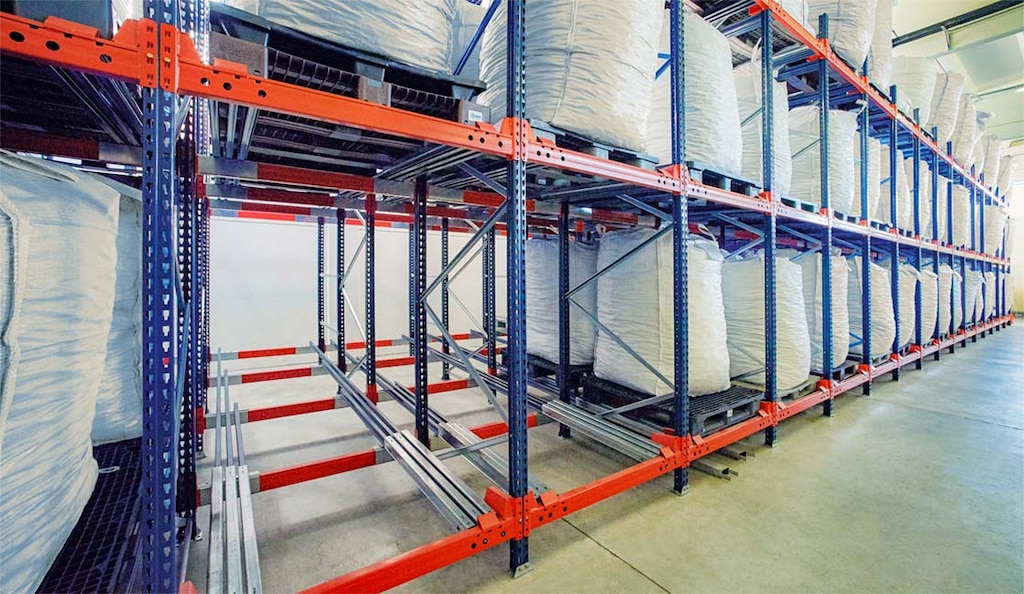
Push-back racking stores multiple pallets deep in slightly inclined lanes. When a new unit load is placed in a lane, it pushes the ones already stored there toward the back. Once the pallet at the front is removed, those behind it move forward by gravity to the pick face.
Loading and unloading take place from a single aisle. Unlike drive-in/drive-through racking, forklifts don’t enter the structure, making maneuvers quicker. The system operates in line with the LIFO principle, and each lane can be assigned to a different SKU.
Pallet flow racking
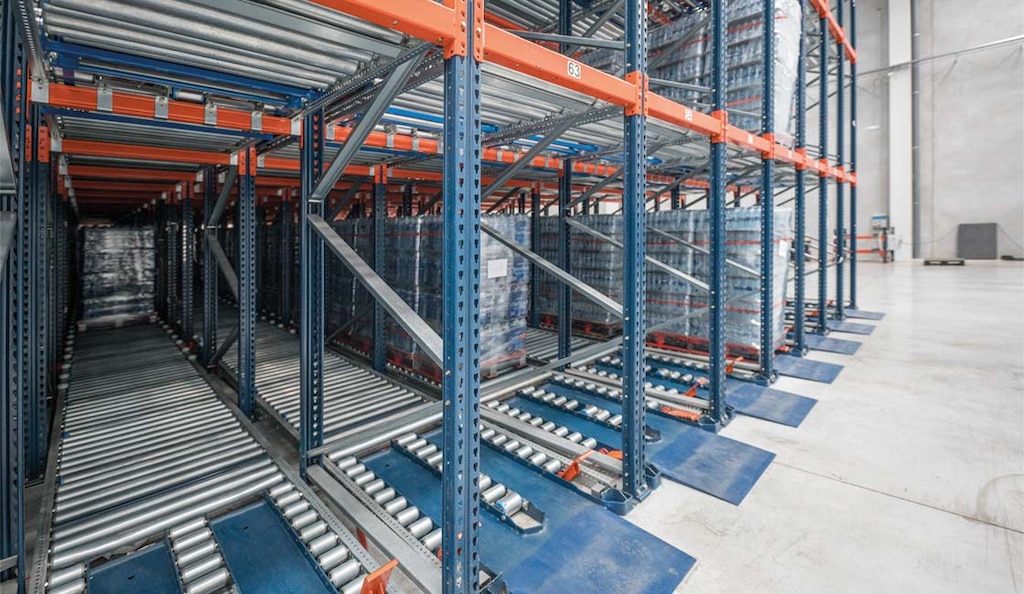
Pallet flow racks feature slightly inclined roller lanes. As with push-back racking, forklifts remain outside the structure. Pallets are loaded at the higher end and move by gravity to the opposite side, where they’re ready for retrieval.
With separate loading and unloading aisles, this solution follows the FIFO principle. It’s suitable for fast-moving goods or products whose manufacturing or expiration dates call for continuous stock rotation.
Semi-automated high-density storage systems
Semi-automated systems incorporate motorized equipment to perform some material handling maneuvers. This combination provides high storage density and faster workflows while retaining some operator involvement.
Mobile racking
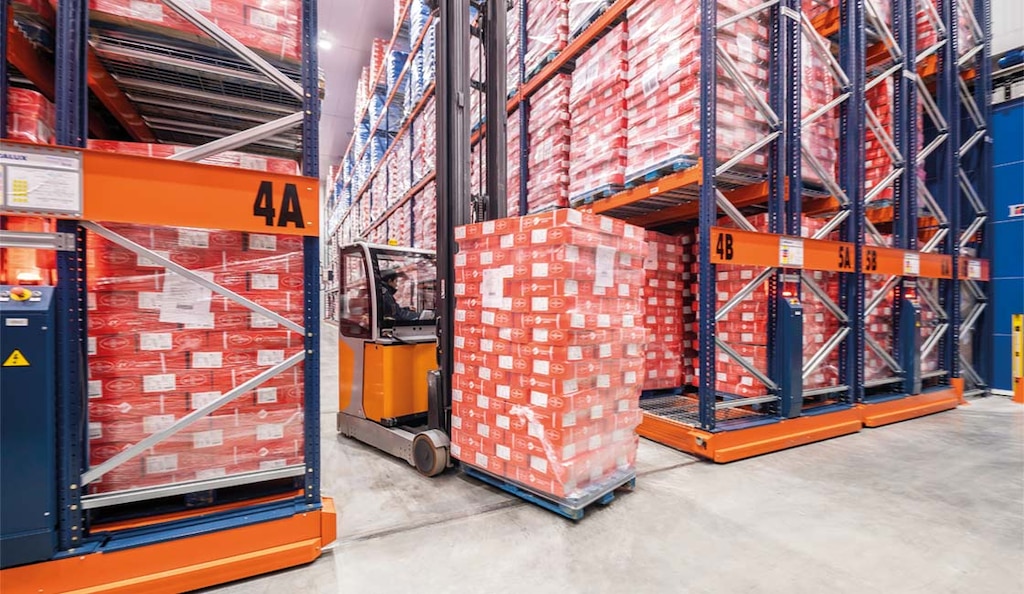
The Movirack mobile racking system consists of racks mounted on motorized mobile bases that travel laterally along rails. Rather than leaving every aisle permanently accessible, the rack units are grouped together, and only the one required to reach a particular location is opened.
Unlike other high-density solutions, Movirack provides direct access to every pallet. This feature makes it easier to handle a large number of SKUs and makes mobile racking particularly advantageous for cold storage, where eliminating unnecessary aisles frees up more refrigerated space for goods.
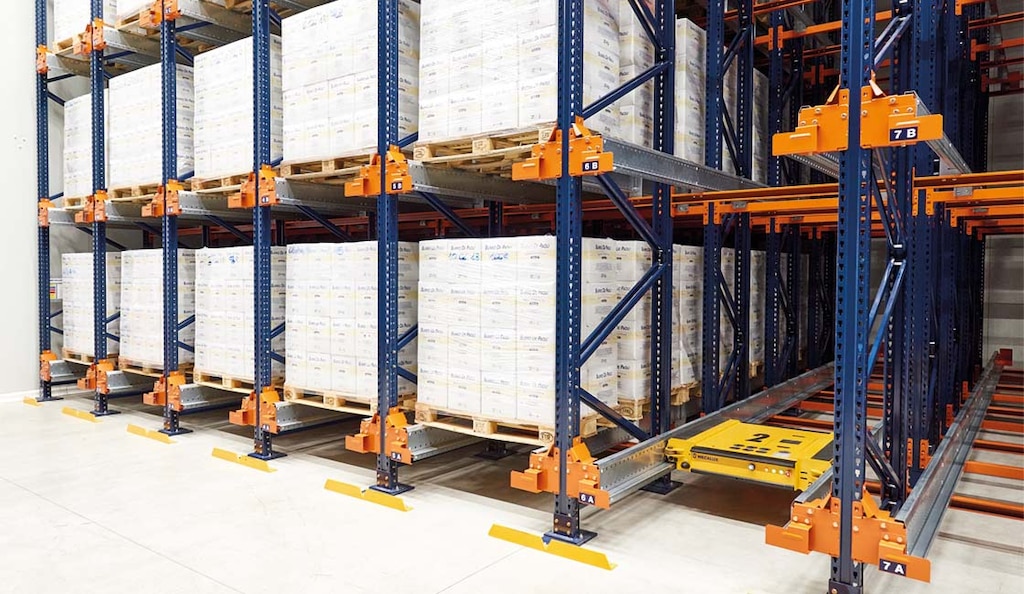
Semi-automated Pallet Shuttle
The semi-automated Pallet Shuttle system features an electric shuttle that travels along rails inside the racking. This eliminates the need for forklifts to enter the storage lanes as they would with a drive-in system. Using a forklift, the operator places the shuttle in the appropriate lane. The unit then transports pallets autonomously.
Compared with conventional drive-in racking, this solution increases productivity, minimizes forklift maneuvers inside the structure, and accommodates very deep storage lanes. It can also be configured for either FIFO or LIFO inventory rotation.
Automated high-density storage systems
For facilities with greater capacity and throughput requirements, high-density storage can be combined with automated handling equipment. These solutions automate pallet receiving, putaway, and retrieval and are coordinated through a warehouse control system (WCS) and a warehouse management system (WMS).
Stacker cranes with pallet flow racks
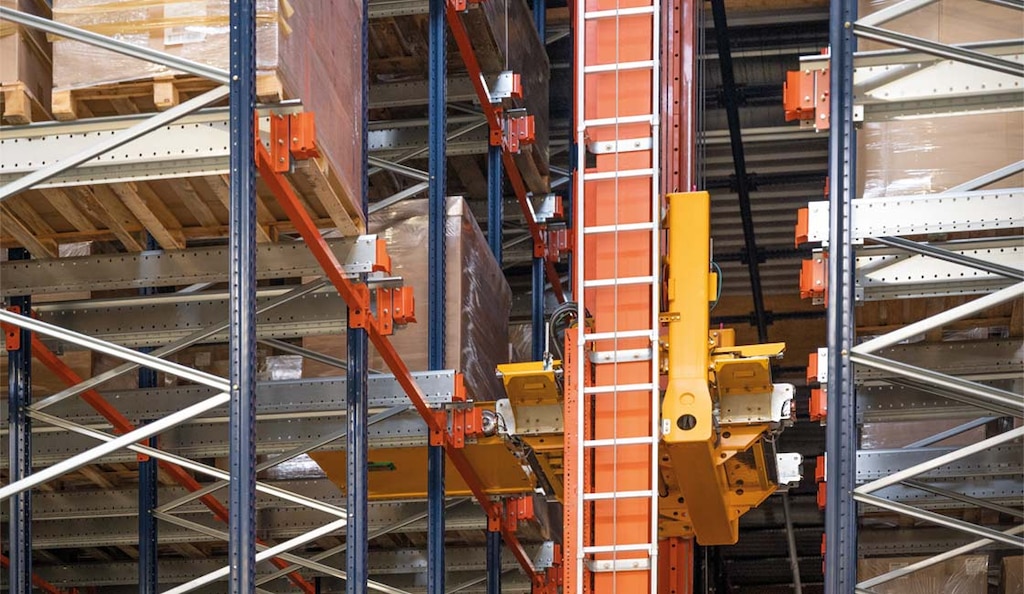
Pallet flow racking can also be integrated into an automated storage and retrieval system (AS/RS). In this configuration, a stacker crane loads and unloads pallets, while roller lanes move them by gravity.
This combination delivers high density and automated FIFO inventory rotation, making it suitable for fast-moving goods and processes with a continuous flow of inbound and outbound pallets. An AS/RS can also be configured with pallet flow racks on the lower level and single- and double-deep racking on the upper levels.
Automated Pallet Shuttle
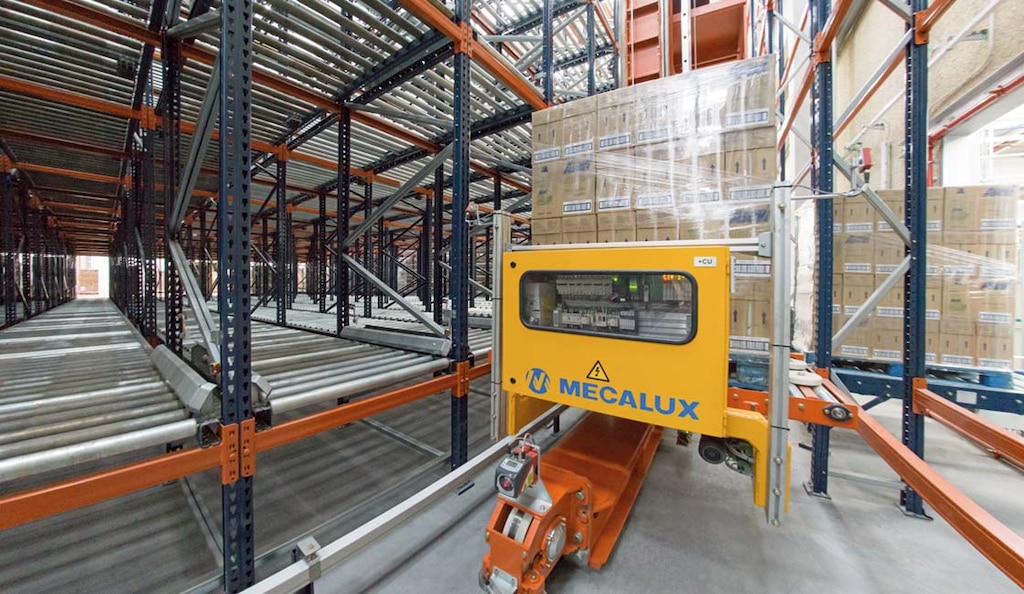
The Automated Pallet Shuttle handles storage and retrieval in high-density racks. A stacker crane or transfer car carries the electric shuttle to the appropriate location, where it enters the lane to move the pallets.
This configuration combines high storage density with increased throughput, making it well suited to facilities with substantial daily goods flows, large quantities per SKU, or automated cold storage.
4-Way Pallet Shuttle
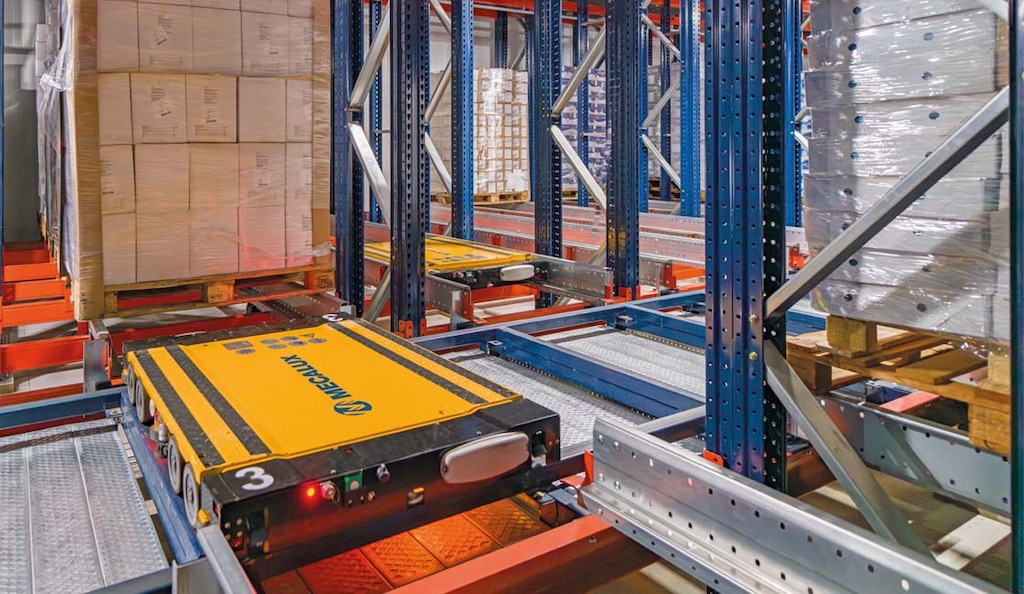
The 4-Way Pallet Shuttle takes high-density storage a step further. It uses autonomous, multidirectional shuttles that travel both through the storage lanes and along the aisles connecting different areas of the racking. Pallet elevators transport the shuttles between levels.
This freedom of movement provides greater flexibility and lets multiple shuttles operate simultaneously within the AS/RS. The system can adapt to demand peaks and scale modularly by adding shuttles, aisles, or levels. These capabilities make it ideal for warehouses that require both high density and enhanced productivity.
How to choose the right high-density storage system
Choosing a high-density storage system starts with analyzing the characteristics of the goods, expected logistics flows, and warehouse layout. Key factors include the number of SKUs, pallets per SKU, stock turnover, inventory management strategy, daily inbound and outbound volume, available space, storage temperature, and required level of automation.
Growth projections should also be taken into account. A solution that meets current requirements may no longer be sufficient if inventory volumes rise or throughput demands increase.
The table below provides an overview of the main high-density storage systems:
| System | Direct access | FIFO/LIFO | SKU variety | Throughput | Automation level |
|---|---|---|---|---|---|
| Drive in/drive-through | No |
FIFO/LIFO |
Low | Low | Manual |
| Push-back | No | LIFO | Medium | Medium | Manual |
| Pallet flow | No | FIFO | Medium | High | Manual |
| Movirack | Yes | Direct access | High | Medium | Semi-automated |
| Semi-automated Pallet Shuttle | No | FIFO/LIFO | Medium | High | Semi-automated |
| Stacker cranes with pallet flow | No | FIFO | Medium | Very high | Automated |
| Automated Pallet Shuttle | No | FIFO/LIFO | Medium | Very high | Automated |
| 4-Way Pallet Shuttle | No | Configurable | High | Very high | Automated |
Examples of companies using high-density storage systems
Capacity, a warehousing and order fulfillment provider, equipped its New Jersey logistics center with a combination of push-back and pallet flow racks to accommodate more goods and make better use of space. Push-back racking follows the LIFO principle and shortens forklift travel by concentrating loading and unloading in a single aisle. Pallet flow racks, meanwhile, rely on gravity and the FIFO method to speed up the movement of goods. “The storage solutions give us room for more products than we thought possible,” says Capacity Industrial Engineer Paul Jakobovic.
Eridania, a leading sugar and sweetener manufacturer in Italy, increased storage capacity at its Russi plant by 180% with the semi-automated Pallet Shuttle. The solution can dispatch up to 1,750 pallets of finished goods per day. “With the semi-automated Pallet Shuttle, we can house large quantities of products — significantly more than when we stacked pallets on top of each other. We’ve gone from storing 2,000 to 5,600 pallets,” says Alessandro Sabbadini, Head of Warehousing, Supply, and Shipping at Eridania.
Clavo Food Factory produces over 15,400 tons of chilled and frozen ready-made foods and supplies more than 42,000 restaurants. The company automated its plant in Tordesillas, Spain, with the 4-Way Pallet Shuttle. The solution provided 50% more storage space without increasing the warehouse footprint and reduced operating times by 20%. “With the 4-Way Pallet Shuttle, we’ve doubled our storage capacity, cut downtime, and lowered costs,” says Alejandro Lara, Plant Manager of Clavo Food Factory’s Tordesillas facility.
More storage and productivity, same space
High-density storage systems can accommodate more goods without expanding a facility’s footprint. Choosing the right solution depends on factors such as product turnover, the number of SKUs, logistics flows, required throughput, and warehouse layout. These key takeaways can help companies choose the best solution:
- Analyze operational needs before selecting a high-density storage system. Consider turnover, the number of SKUs, and goods flows.
- Prioritize high-density solutions when the goal is to increase capacity without expanding the warehouse footprint or building a new facility.
- Choose a system based on the required FIFO or LIFO strategy, as each high-density solution supports different inventory management needs.
- Consider automation for facilities with large volumes of goods movement to boost productivity and limit manual intervention.
High-density storage systems: 5 FAQs
Why use high-density storage systems?
High-density systems fit more goods into the same footprint by minimizing aisles and making better use of vertical space. They can eliminate the need to expand a warehouse, acquire additional land, or spread inventory across multiple facilities. Instead, they free up floor space for production, picking, or other activities.
What’s the difference between FIFO and LIFO in a high-density storage system?
With FIFO (first in, first out), the first pallet stored is the first retrieved, making this approach ideal for perishable or fast-moving goods. With LIFO (last in, first out), the most recently stored pallet leaves first, an appropriate strategy for homogeneous goods without strict expiration requirements.
Which high-density storage system is best for each type of product?
For large quantities of the same SKU, drive-in racking or the Pallet Shuttle can be a good fit. Perishable and fast-moving goods benefit from FIFO pallet flow racks. Push-back racking is suitable for multiple lanes managed according to LIFO, while mobile racks provide direct access when storing a wider variety of SKUs.
When should you choose a manual, semi-automated, or automated system?
Manual systems are appropriate for moderate goods flows and a lower initial investment. Semi-automated solutions provide greater density and faster movements as operational demands grow. Automation is optimal for facilities with substantial product flows, intensive operations, high-bay racking, cold chain storage, or demanding throughput and management requirements.
What role does a WMS play in high-density storage systems?
A warehouse management system (WMS) controls inventory and assigns storage locations based on criteria such as SKU, lot, expiration date, or FIFO/LIFO strategy. In automated facilities, it also works with the WCS and WES to coordinate goods flows with the systems governing the equipment. This ensures each pallet is stored and retrieved at the right place and time.