


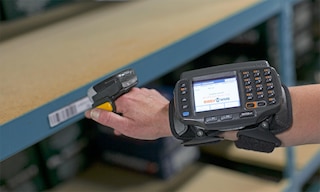
Ring scanner: What it is, how it works, and how it boosts warehouse efficiency
A ring scanner is a tool that helps businesses with warehouses handle rising ecommerce pressure and higher service expectations. These devices raise operational efficiency through laser reading or imaging technology that captures barcodes during daily tasks.
In this post, we break down what a ring scanner is and how it works. We also highlight the main types available, when they’re recommended, and how to introduce them into a warehouse environment.
What is a ring scanner?
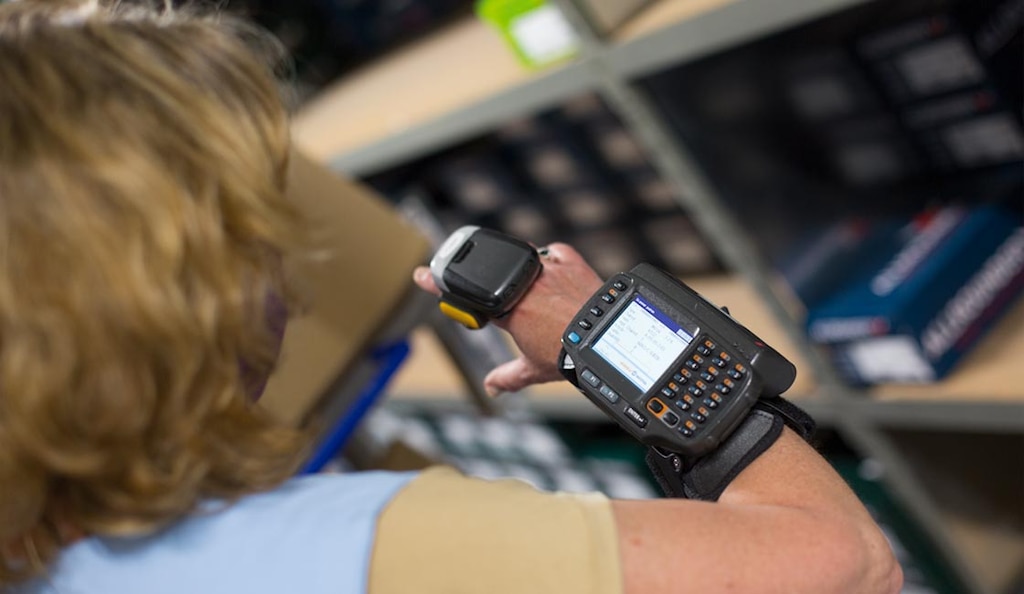
A ring scanner is a compact data-capture device worn on a person’s finger and secured with a strap. Unlike traditional barcode readers like RF scanners, it’s designed for hands-free use. This allows associates to keep one hand free, making it easier to handle boxes, equipment, and other items without putting the scanner down. Models vary in shape and can be paired with other wearables, such as wrist-mounted devices.
Built for demanding environments, barcode ring scanners withstand impacts and thousands of scans per day. Well-known brands include Zebra, Honeywell, and Unitech. Ring scanners differ from multifunctional smart rings, which interact with chips and NFC tags but can’t read barcodes. Ring scanners, on the other hand, can process both barcodes and QR codes. They’re commonly utilized in order picking, packing, replenishment, sorting, and cross‑docking operations, where speed and mobility are crucial.
How do ring scanners work?
Ring scanners are worn on the user’s finger, enabling hands-free work across warehouses, retail stores, and industrial settings. They rely on scanning technologies such as laser or image capture to collect data quickly and accurately. The ring usually sits on the index or middle finger, depending on the model.
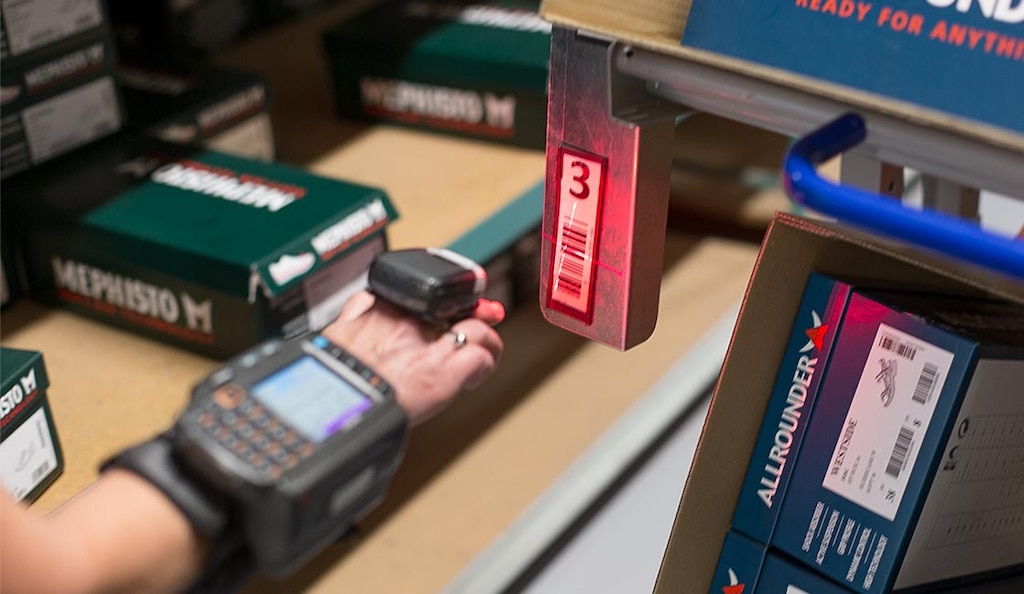
Workers point at a barcode with the finger-mounted device, which captures the information and transmits it wirelessly to another device (typically through a ring scanner Bluetooth connection). That device then communicates with software systems that process the data. Feedback is provided through visual, audible, or vibration signals to confirm a successful scan. A terminal or wearable connected to the scanner may also display the next task or product location within the facility. This technology integrates well with pick-by-vision and voice picking systems.
Types of ring scanners
Ring scanners are classified based on reading technology. Below are the most relevant types:
1D ring scanners
These models project a laser beam that reflects off a barcode. A sensor then measures the intensity of the returning light. Since this method reads in one direction, it only processes 1D barcodes and is incompatible with QR codes.
2D ring scanners
These scanners work more like digital cameras. They use an image sensor, usually CMOS, to convert light into digital signals. This capability enables them to read both 1D barcodes and 2D codes such as QR codes from multiple angles, making 2D ring scanners expedient in fast-paced environments.
Mid- and long-range ring scanners
Some models include lenses or lighting elements that allow reading from several feet away. This feature can speed up workflows in warehouses where, for instance, an associate needs to scan a location without getting off the forklift. In these cases, larger or reflective codes improve performance.
What are the advantages of using a ring scanner?
Adopting a wireless ring scanner in warehouse operations or retail environments brings several benefits:
- Hands-free operation. Workers can perform other tasks while scanning, such as moving loads, palletizing, or handling equipment. This removes the need to pick up and set down a device repeatedly, streamlining workflows.
- Faster high-volume picking. The scanner remains on the worker’s finger, resulting in more scans per hour.
- Reduced damage. Since the device remains secured (often via a strap), the risk of drops and breakage is minimized.
Are there any drawbacks?
Despite their strengths, ring scanners come with some limitations:
- Shorter battery life. Compact size often means smaller batteries. Careful charging routines help sustain performance during long shifts or continuous scanning modes.
- Wear and tear. Frequent usage can affect components such as the trigger button or Velcro fastening strap, especially in environments with intensive handling.
- Limited range. While some models support longer distances, many are designed for short-range scanning. This constraint may restrict certain usage scenarios.
When is a ring scanner recommended?
A ring scanner is a go-to solution when a company’s goals are higher productivity, better ergonomics, and hands-free operations. It works best in environments where workers handle goods continuously and perform frequent scans.
Ring scanners are widespread in order picking, where they speed up product identification without requiring a more cumbersome handheld device. The improved agility reduces time per order while improving workflow continuity.
This technology is also recommended for operations with high product turnover or large numbers of order lines, where even small gains in scanning speed have a noticeable impact on productivity.
Facilities that employ voice picking and wearables can also benefit from ring scanners, as these enable smooth interaction with warehouse management software.
Implementing ring scanners in a warehouse
The first step is to assess whether this technology fits operational needs. Consider product size, warehouse layout, and number of items handled daily.
After doing a cost-benefit analysis, select the appropriate system. Most ring scanners connect via Bluetooth to a mobile or wearable device, which then links with a warehouse management system such as Interlake Mecalux’s Easy WMS.
Next, train staff on scanning techniques and accessing product data. Ongoing performance reviews help track scan speed, error rates, and inventory accuracy.
Rouje boosts productivity with ring scanners
French fashion brand Rouje upgraded its logistics processes by deploying Easy WMS in its Palaiseau warehouse. Digitalization improved omnichannel order fulfillment for both online customers and retail stores.
Workers now utilize ring or RF scanners to capture barcode data quickly and accurately. The system assigns tasks and distributes workloads across the team. With this setup, the scanner is worn on the employee’s finger, while the mobile device is secured to their arm. Thanks to Easy WMS’s organizational and digital support, Rouje increased picking productivity by 20%.
The ring scanner as a performance driver
Ring scanners streamline processes without adding operational complexity. Their compact design and ability to integrate with digital systems enhance traceability and coordination in dynamic environments. While they don’t replace all data-capture solutions, ring scanners are an effective alternative when mobility and speed are priorities. Choosing the right model and aligning it with existing workflows are essential for maximizing performance. Ultimately, this specialized technology delivers real value when integrated into a well-planned logistics strategy.
Ring scanners in 5 questions
What is a ring scanner used for?
A ring scanner is a data-capture device secured to the finger with a strap to allow for hands-free barcode scanning. It facilitates productivity gains in logistics, particularly in order picking and inventory control.
How do ring scanners help increase productivity?
They enhance ergonomics without compromising worker efficiency in retail, warehousing, and other material-handling environments. They enable people to scan items without picking them up or setting them down.
What is the difference between 1D and 2D ring scanners?
A 1D scanner utilizes laser technology to read standard barcodes. Meanwhile, a 2D ring scanner works like a camera, capturing entire images to read both traditional and QR codes from multiple angles. This option offers greater flexibility, as it doesn’t require precise aiming.
What are the pros and cons of ring scanners?
They enable hands-free, fast, ergonomic picking and smoother workflows. On the downside, battery life and scanning range may be more limited compared to larger devices. They may also experience wear in critical areas such as the Velcro fastening.
How do ring scanners connect to a WMS?
They connect indirectly. Generally, they transmit data via Bluetooth to a mobile terminal or wearable device, which is integrated with the WMS and processes the information in real time.