



Types of AI agents: Classification, examples, and applications
There are multiple types of AI agents, ranging from rule-based systems to advanced solutions capable of reasoning, learning, and collaborating in complex environments. Their versatility has turned them into a strategic driver for process automation, decision-making, and operational efficiency. Still, not all types of AI agents serve the same purpose. Understanding their classification is critical in business, industrial, and logistics settings.
In this post, we explore the five main types of agents in artificial intelligence, how to integrate them into business, industrial, and logistics environments, and other emerging models shaping the future of advanced systems.
Why are there different types of AI agents?
The variety of AI agents available today exists because not all systems operate in the same way or tackle the same challenges. In broad terms, AI agents are software- or hardware-based entities that perceive their surroundings and apply artificial intelligence techniques to make decisions and complete tasks autonomously.
Since their capabilities and limitations vary by model, understanding their classification is essential before implementation. Some react instantly to environmental stimuli, while others plan, evaluate alternatives, or learn through experience. Therefore, they’re categorized according to their decision-making abilities, interaction methods, and complexity levels, making it easier to identify the most suitable solution for each use case.
The potential of these different types of agents for transforming business, industrial, and logistics processes is promising. According to McKinsey, at least 64% of organizations are already experimenting with AI agents, while Gartner predicts that they will become the new normal in enterprise applications by 2029.
The 5 main types of AI agents
Understanding how AI agents perceive their environment helps explain how they make decisions. Below are the five main categories, from the simplest systems to the most advanced models capable of continuous improvement.
Simple reflex agents
As the most basic types of AI agents, these systems follow predefined rules to make decisions without considering past experiences or future outcomes. They respond directly to environmental conditions. Thermostats are a classic example of a simple reflex agent. They activate when the temperature falls below a set threshold and switch off once the target temperature is reached. They don’t retain previous information, so they may repeat mistakes when predefined rules are insufficient for handling unfamiliar situations.
Model-based reflex agents
Model-based reflex agents represent a more advanced version because they include an internal representation of their surroundings. This allows them to monitor environmental changes and understand the impact of previous interactions. They also update their internal state before making decisions accordingly. Autonomous mobile robots (AMRs) navigating in warehouses are a case in point. These machines can react to obstacles they have already encountered and incorporate previous movements when generating routes.
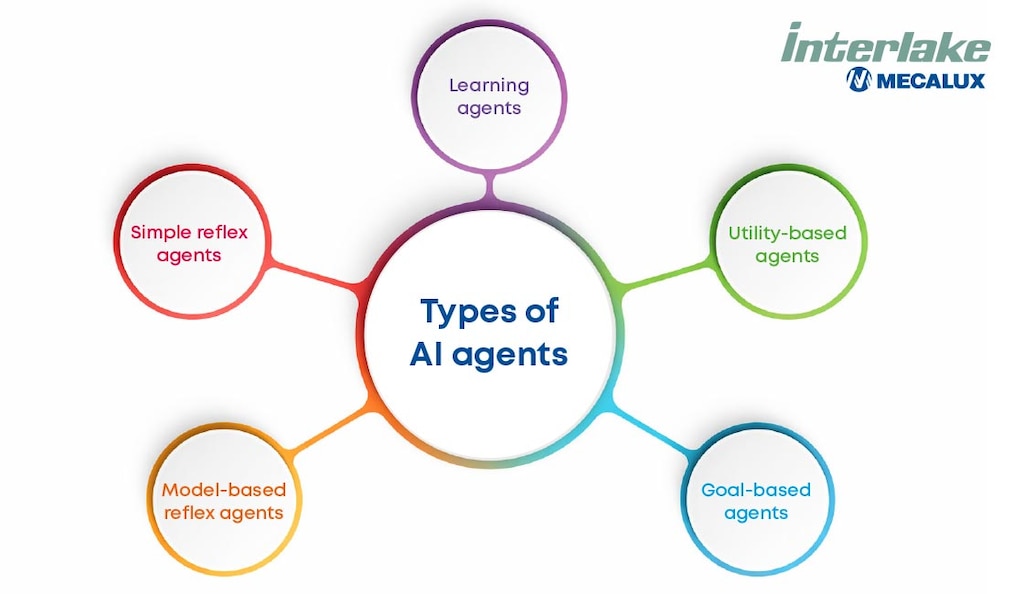
Goal-based agents
Among the most common agent types are goal-based agents, which plan and reason to choose actions that move them closer to a target. In general, they select the option with the highest probability of success. GPS navigation systems operate as goal-based agents when calculating the best route to a destination. They compare multiple alternatives and choose the one most likely to achieve the objective based on factors such as distance, traffic conditions, and estimated arrival time.
Utility-based agents
These agents do more than pursue a specific goal. They compare available alternatives according to the expected benefit of each option. This approach is particularly valuable in environments with multiple criteria or competing priorities. For instance, in an ecommerce business, a utility-based agent may adjust prices and recommend products by taking into account sales history, customer preferences, and inventory levels.
Learning agents
As some of the most advanced types of agents in artificial intelligence, these systems fine-tune their performance over time and adapt to changing situations. Their behavior evolves continuously according to environmental feedback, which helps them perform better. As learning agents analyze historical and real-time data — such as vibrations, temperatures, or usage patterns — they refine their models to detect anomalies more accurately and optimize maintenance activities.
Other types of AI agents
Beyond the most common AI agents, other operational models are designed to support more complex systems. Below are several examples focused on organizational structure and functional roles.
Hierarchical agents
Hierarchical agents organize decision-making into multiple levels, where a primary agent handles planning and delegates tasks to specialized sub-agents. This structure makes it possible to solve complex problems by dividing them into smaller subtasks, improving coordination and efficiency across environments with numerous processes. In a customer service platform, for instance, a main agent may interpret a user request and route it to sub-agents dedicated to billing, technical support, or returns.
Multi-agent systems
Multi-agent systems consist of autonomous agents interacting within a shared environment. They may work independently or collaboratively to accomplish individual or common objectives. In urban traffic management, different agents can control traffic lights at separate intersections while coordinating with one another to minimize congestion. This model is also being explored in advanced logistics operations, such as the joint MIT and Mecalux research project in which AMR fleets function as coordinated multi-agent systems to optimize warehouse flows.
Hybrid agents
Hybrid agents combine several decision-making approaches (reactive behavior, goal-based planning, and learning capabilities) within a single system. This structure enables them to adapt to complex environments while leveraging the strengths of each method depending on the situation. An advanced virtual assistant, for example, may answer simple questions immediately, manage more complex actions (such as incident resolution), and refine future responses through user interactions.
Role-based agents
Role-based agents are defined by the specific function they perform within a system, streamlining task organization and distribution. These may include customer service agents, employee support tools, creative systems, data analysis platforms, coding assistants, or security-focused solutions. Within a company, several agents may handle customer inquiries, aid employees, or identify cybersecurity threats. Their specialization boosts overall operational performance.
How to integrate different types of AI agents
In practice, organizations generally integrate multiple types of agents into a single system to leverage their complementary capabilities, from immediate reactions to planning and continuous learning. As University of Washington Professor Chirag Shah explains, AI agents are expected to transform how businesses operate and collaborate with technology, especially when implemented as assistants combining automation, information access, and support for human decision-making.
Business environments
In corporate settings, AI agents are common in customer service, data analysis, and software development processes. Utility-based agents may refine pricing and recommendation engines, while learning agents increase personalization capabilities. Role-based solutions — such as customer service or coding assistants — also specialize in specific organizational functions.
To integrate them, companies typically embed these systems into existing software tools connected to corporate data sources and platforms. This approach allows AI agents to automate tasks, generate relevant insights, and optimize decision-making without replacing human teams. The growing adoption of AI highlights the importance of understanding the various types of agents in business and how they can facilitate different operational goals.
Industrial environments
In industrial operations, reflex and model-based agents are utilized in automation and control systems, where speed and reliability are crucial. Learning agents are also employed in predictive maintenance applications, enhancing performance through operational data.
Integration usually takes place within control systems and monitoring platforms, where agents process real-time information to interact with equipment or production processes. This makes it possible to align fast real-time responses with analysis and continuous improvement capabilities.
Logistics environments
In logistics, organizations frequently combine multiple AI models. Goal-based agents plan routes and tasks, utility-based systems streamline resources and schedules, and multi-agent or hierarchical systems coordinate inventory management and warehouse operations.
In these environments, AI agents are integrated into warehouse management systems (WMSs). This software facilitates real-time decision-making, resource optimization, and dynamic adaptation to fluctuations in demand or operations. For example, Interlake Mecalux has upgraded its technology architecture to integrate AI agents into its logistics software solutions.
AI agent types: The gateway to new applications
The diverse types of AI agents available today reflect the wide range of challenges these systems can address and the need to tailor their behavior to each environment. Their value lies in their integration into broader systems, where capabilities such as reaction, planning, and learning are orchestrated in a coordinated way. In real-world applications, this complementarity enables the development of more scalable, resilient, and efficient solutions. As AI continues to evolve, understanding these differences not only simplifies implementation but also opens the door to new applications and operating models across multiple industries.
Types of AI agents, in 5 questions
How many types of AI agents are there?
On the whole, there are five main types of AI agents: simple reflex agents, model-based reflex agents, goal-based agents, utility-based agents, and learning agents. Additional models include hierarchical agents, multi-agent systems, hybrid agents, and role-based agents.
What types of AI agents are best suited for each industry?
The best option depends on the requirements of each sector. In business environments, utility-based and learning agents stand out because of their ability to improve decision-making. In industrial settings, reflex and model-based agents are central to automation and control tasks. In logistics, multi-agent systems and goal-based agents play a major role in operational planning and coordination.
Examples of utility-based AI agents in real-world applications
Utility-based agents are widely used in dynamic pricing and recommendation systems for e-commerce. They’re also integrated into navigation software apps that streamline routes according to traffic, weather, and costs, evaluating multiple variables to maximize overall benefit.
Differences between goal-based and utility-based agents
Goal-based agents focus on reaching a specific target by selecting actions that help achieve it. Utility-based agents, on the other hand, compare options according to expected value. This approach allows for more nuanced decisions when several criteria or outcomes must be considered.
Advantages and limitations of simple reflex agents
Simple reflex agents are fast, efficient, and easy to implement because they respond directly to stimuli without requiring memory or advanced processing. Their main drawback is that they do not consider context or previous experiences, which limits their effectiveness in unpredictable environments.