


Forklift safety: 25 tips and standards/regulations
Forklift safety is essential for logistics facilities where heavy equipment, palletized goods, and employees on foot share the same workspace. Following proven warehouse safety tips helps daily processes run smoothly while lowering the risk of incidents. Safe forklift operation involves a combination of driver training, organized workflows, preventive measures, and well-planned layouts.
This post explores practical ways to improve forklift truck safety, from proper operating procedures and safety requirements to the technologies available for safer warehouse processes.
25 forklift safety tips for daily warehouse operations
Forklift safety awareness comes from consistent habits and informed decision-making throughout the workday:
BEFORE USING THE FORKLIFT
1. Choose the right forklift for the facility
Not every lift truck is designed for the same environment. Selecting suitable equipment requires evaluating aisle width, floor conditions, and whether operations take place indoors, outdoors, or in both settings.
2. Train and certify drivers
These employees must be fully trained in machine use. Operators should understand the machine’s capabilities, limits, and potential hazards. Training should also cover workplace risks, emergency response procedures, and safe handling practices.
3. Carry out daily inspections
A forklift safety checklist should be gone through before every shift. Operators need to inspect tires, brakes, warning devices, lights, fluid levels, and hydraulic systems. Additionally, they need to check for leaks and visible damage. Routine inspections support forklift safety and OSHA compliance while helping prevent mechanical failures.
4. Wear appropriate PPE
While not specific to the forklifts themselves, warehouse PPE (personal protective equipment) plays a vital role in operator safety. Depending on site conditions, these workers may need high-visibility (hi-vis) clothing, slip-resistant safety footwear, and/or protective gear for cold and damp environments.
5. Use forklifts equipped with overhead guards
Modern forklifts include overhead protection systems that shield drivers from falling objects and help lessen injuries during a rollover incident.
DURING FORKLIFT OPERATION
6. Never exceed load capacity
Forklift safety rules require operators to observe the load chart provided by the manufacturer. Weight limits vary according to lift height and load placement. Some machines incorporate integrated weighing systems or load monitoring technology that prevents unsafe lifting.
7. Always wear the seat belt
Seat belts are mandatory on seated forklifts. They help keep the operator inside the protected zone created by the overhead guard if the truck tips over.
8. Never transport passengers
Forklifts are designed for material handling only. Carrying workers on the forks, pallet, or chassis poses a serious risk of falling and injury.
9. Consider load dimensions and center of gravity
Before moving goods, operators should evaluate the size, weight distribution, and stability of the load. Unbalanced or unsecured materials can shift during travel and compromise safety forklift procedures.
10. Secure the load properly
Palletized goods must remain stable throughout handling operations. Loads should be wrapped, strapped, or otherwise secured on pallets in good condition to avoid collapse and damage.
11. Travel with the load lowered
Driving with elevated forks limits visibility and truck stability. Keeping the load close to the floor improves control and helps avoid collisions with racks, structures, or equipment.
12. Maintain safe travel speeds
Forklift driver safety relies heavily on speed control, allowing these employees to react in time to obstacles, pedestrians, or unexpected maneuvers. Operators must adapt driving speed to traffic conditions, visibility, and available operating space.
13. Use caution at intersections and blind spots
Extra care is necessary in narrow aisles, crossings and low-visibility areas. Operators must slow down and confirm the route is clear before proceeding.
14. Avoid sudden turns or abrupt movements
Sharp turns, rapid acceleration, and hard braking raise the likelihood of tip-overs. Smooth handling contributes to forklift operation safety while protecting both personnel and products.
15. Avoid simultaneous maneuvering and driving
Lifting operations and vehicle movement should occur separately. Performing both actions at once increases instability and reduces control.
16. Reverse carefully and look in the direction of travel
When backing up, operators must verify that the path is clear and remain focused on the direction of movement. This is especially important when carrying bulky loads that restrict forward visibility.
17. Maintain visual contact with pedestrians
Warehouse forklift safety requires clear communication between vehicle operators and staff on foot. Eye contact and safe spacing help coordinate movements and prevent the risk of accidents.
18. Follow designated traffic lanes
Forklift safety procedures require industrial trucks to remain within marked travel routes. Separating pedestrian and vehicle traffic lowers the chance of collisions and damage to racking or other warehouse elements.
19. Stay clear of forks and maneuvering areas
No worker should stand beneath elevated forks or within the forklift’s operating radius. Maintaining a safe distance between forklifts and nearby employees avoids the risk of being struck, run over, or crushed.
AFTER USING THE FORKLIFT
20. Park only in designated areas
When not operational, forklifts should remain in approved parking zones without blocking exits, aisles, stairways, or emergency equipment. Forks must rest flat on the floor.
21. Secure the forklift before leaving it unattended
Before stepping away from the machine, operators should engage the parking brake, switch off the engine, place controls in neutral, and remove the ignition key.
22. Never park on an incline
Forklifts mustn’t be parked on slopes or ramps. Whenever possible, they should be parked on level ground in designated areas.
23. Do not make unauthorized modifications
Changes to forks or structural components can alter truck stability and create unsafe operating conditions. Fork lift truck safety involves keeping equipment consistent with manufacturer specifications.
24. Keep equipment and the workspace in optimal condition
Safe forklift operation requires smooth flooring, clear of debris, spills, or irregularities. Adequate lighting and visible signage also minimize accident risks and facilitate safe vehicle handling.
25. Schedule preventive maintenance
Regular servicing performed by qualified technicians is crucial for long-term forklift truck health and safety. Routine maintenance should include inspections of steering systems, lights, hydraulics, brakes, tires, lifting mechanisms, and fluid levels. Following the manufacturer’s maintenance schedule helps avoid equipment failure and makes the work environment safer.
Forklift safety standards
Safety in forklift operation is grounded in regulations designed to manage risk and ensure equipment is used correctly. These standards cover everything from the machines themselves to the environments where they operate. Below is a breakdown of applicable safety regulations:
United States
In the US, forklift safety is governed by Occupational Safety and Health Administration (OSHA) standards. These practical requirements and safety-first approach serve as a global benchmark for risk prevention.
- OSHA 29 CFR 1910.178 – Powered industrial trucks. This is the primary OSHA forklift safety standard. It establishes training requirements, mandates daily forklift inspections, and outlines maintenance procedures. It also defines the specific conditions that must be met before a vehicle is placed into service.
- OSHA 29 CFR 1910.176 – Handling materials - general. This standard addresses safe material handling, storage aisle organization, and traffic routes within industrial facilities. Its requirements are designed to prevent hazardous conditions caused by improper pallet stacking, obstructions, or insufficient forklift clearances.
- OSHA 29 CFR 1910.37 and 29 CFR 1910.38 – Exit routes and Emergency action plans. These standards govern emergency exits and evacuation procedures. Facilities using forklifts must keep routes unobstructed and maintain response plans for critical situations.
- OSHA 29 CFR 1910.132 – Personal protective equipment. This standard covers risk assessments and PPE usage when workplace hazards can’t be eliminated through engineering or administrative controls. In forklift environments, this standard supports internal mandates for hi-vis vests, safety-toed footwear, and other gear that helps prevent accidents through increased visibility and protection.
- ANSI/ITSDF B56.1-2020 – Safety Standard for Low Lift and High Lift Trucks. Although not a federal law in itself, this guideline from the American National Standards Institute provides widely accepted criteria for safe forklift operation, maintenance, and workplace practices. Its recommendations complement OSHA requirements and are frequently used as the baseline for establishing internal operating procedures and safety rules in logistics centers.
Europe
Across Europe, forklift truck safety regulations are governed by directives that establish uniform requirements for machinery design, risk assessment, and operator training. These standards are then adapted into the specific legislation of each member state.
- Directive 2006/42/EC (on machinery): Establishes the essential safety requirements manufacturers must meet before marketing a forklift within the European Union. Key obligations include integrating risk assessments into the design and production process, clearly defining usage limits, and identifying potential operational hazards. Compliance can be demonstrated through harmonized technical standards, such as ISO 3691. Beginning January 20, 2027, the directive will be replaced by Regulation (EU) 2023/1230 on machinery.
- Directive 2009/104/EC (on work equipment): Stipulates the minimum safety and health requirements for the use of work equipment, including forklifts. A core principle is that only authorized and properly trained personnel are permitted to operate this machinery. Furthermore, it mandates specific protection against rollover risks, requiring a protected driving position and safety features designed to mitigate the consequences of a tip-over or entrapment.
- Directive 89/391/EEC (on the safety and health of workers): Establishes the general principles for workplace risk prevention across the European Union. It requires companies to conduct thorough workplace hazard assessments, develop preventive action plans, and provide comprehensive safety training to staff on operational risks. Regarding forklift use, this directive serves as the foundation for implementing safe work procedures, defining internal traffic rules, and ensuring warehouse layouts minimize hazardous situations.
Technology for safer forklift operations
Automated storage and material handling solutions can improve forklift safety by reducing interaction between equipment, personnel, and palletized loads. In addition to optimizing processes, automation can minimize reliance on lift trucks in specific zones and operations.
In high-density, fast-moving warehouses, partially or fully automating certain flows helps eliminate repetitive forklift maneuvers, traffic intersection risks, and unsafe conditions. Companies achieve this by implementing automated storage and retrieval systems (AS/RSs) such as stacker cranes and the 3D Automated Pallet Shuttle, as well as conveyors, AMRs, and AGVs for pallet handling and internal transport.
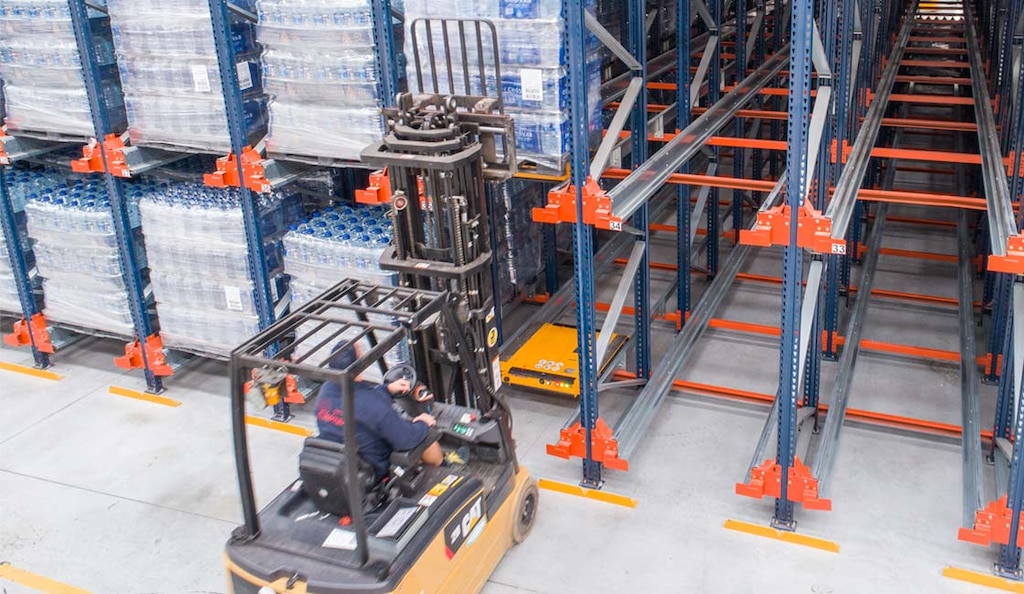
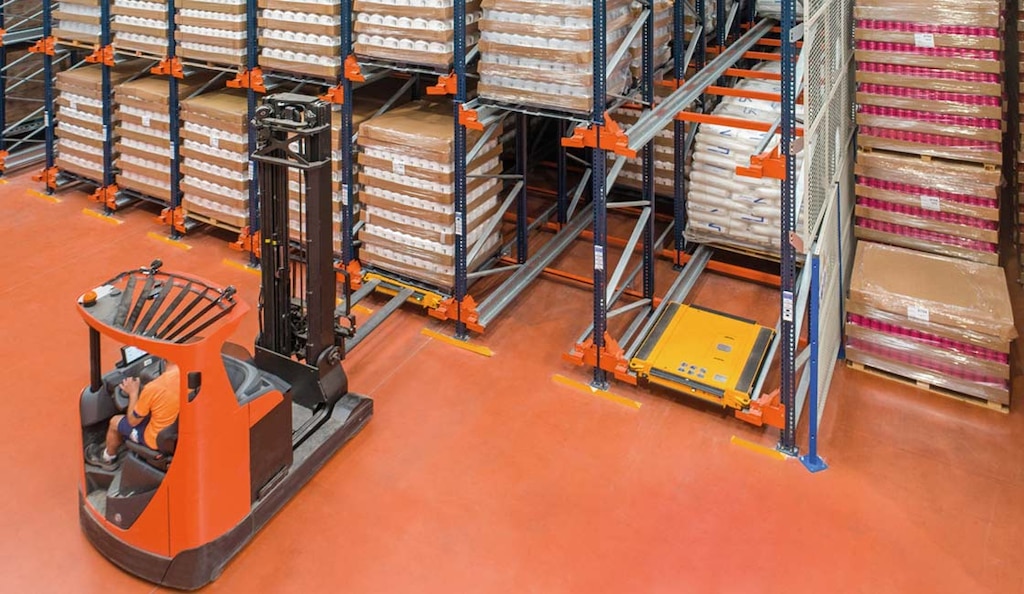
For instance, when working with drive-in racking, the semi-automated Pallet Shuttle introduces and removes loads without forklifts entering storage lanes. This reduces rack impacts and difficult maneuvering in confined areas.
The 3D Automated Pallet Shuttle takes automation further by handling pallet entry, storage, and retrieval movements independently. Multidirectional shuttles travel throughout the racking block without requiring forklift access, minimizing industrial vehicle traffic in the storage area.
Autonomous mobile robots (AMRs) also contribute to forklift safety in facilities. Equipped with sensors and navigation systems, these robots detect obstacles, dynamically adjust their routes, and maintain safe travel distances.
Safety, efficiency, and technology
Forklift safety depends on a comprehensive strategy that combines equipment design, employee training, traffic management, and regulatory compliance. Everyday decisions — from a pre-shift inspection to maintaining safe travel speeds — play a major role in keeping warehouse operations safe and running smoothly.
While standards and regulations provide the legal framework, internal policies and a preventive culture turn those requirements into routine practices. Clear warehouse signage, periodic inspections, and oversight from qualified safety professionals all contribute to optimal equipment and working conditions. Technology also plays an increasingly significant role in warehouse forklift safety by reducing vehicle circulation and automating high-risk movements.
Investing in safer processes not only lowers accident risks but also boosts operational efficiency, protects infrastructure, and supports a more reliable supply chain.