


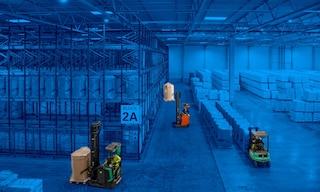
Forklift capacity chart: How to use it
A forklift capacity chart is an essential reference in warehouse operations. Contrary to a common misconception, a forklift’s lifting capability isn’t always fixed. The amount of weight these vehicles can handle depends on factors such as lift height and load position. Understanding what affects these limits helps prevent accidents while supporting efficient material handling throughout the facility.
This post explains how to read a forklift load chart correctly and how it applies to everyday warehouse tasks.
What is a forklift capacity chart?
A forklift capacity chart is a graphical representation of the maximum load a machine can handle under specific operating conditions. Variables such as lift height and the pallet’s location on the forks influence the truck’s capability. In other words, a forklift can carry different amounts of weight depending on the circumstances.
The chart is typically presented as a table and appears on the forklift data plate in a visible location on the truck. Its purpose is to help warehouse personnel identify the equipment’s operating limits and work within them.
In some ways, forklift load charts resemble RMI signs (rack specification plates), which indicate the maximum weight each storage level can support. Both serve as quick-reference tools that allow operators to determine safe working limits at a glance.
What does a forklift data plate show?
A forklift nameplate or data plate provides information about lift height and the position of the load in relation to the mast. These data are usually displayed in a table with predefined values.
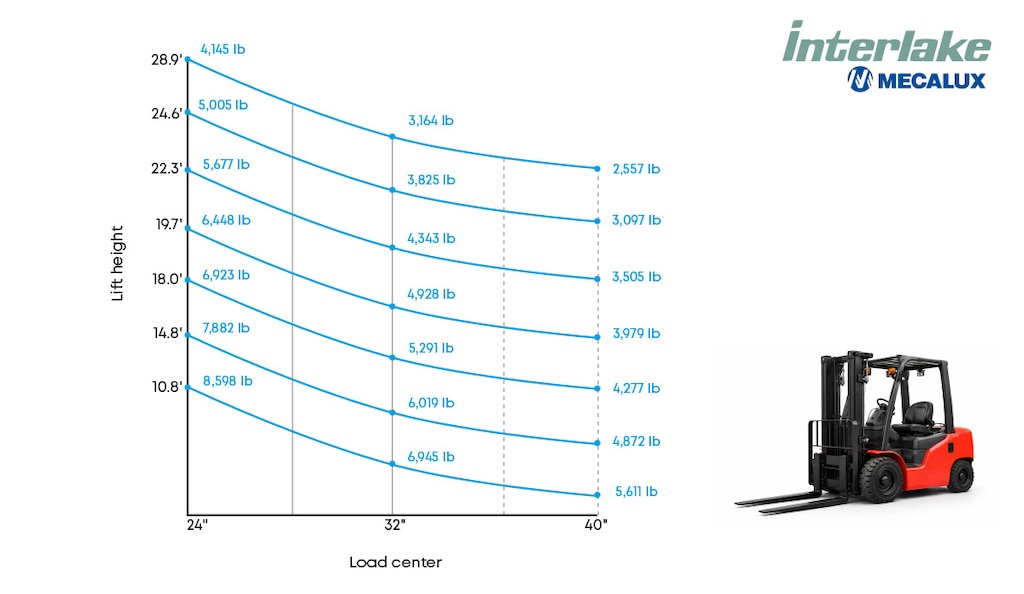
The values are organized according to two parameters. The Y-axis (vertical) indicates lift height, and the X-axis (horizontal) represents the forklift load center, or the location of the load’s center of gravity. As the lift height increases and the load moves farther away from the mast, the truck can handle less weight. If a pallet extends beyond the forks, its center of gravity shifts outward, reducing the machine’s safe lifting capability.
The information contained in a forklift weight capacity chart is closely linked to the forklift stability triangle. This concept explains how a truck maintains balance through its three support points: the two front wheels and the rear axle. The stability triangle defines the area in which the combined center of gravity must remain for safe operation. As a load is raised or positioned farther from the mast, the center of gravity moves. If it extends beyond the boundaries of the forklift stability triangle, the likelihood of a tip-over increases significantly.
How to read a forklift capacity chart
Understanding a forklift load capacity chart involves knowing what factors affect the maximum weight a truck can handle under different conditions.
Rated capacity and residual capacity
Rated capacity is the maximum value specified by the manufacturer under defined operating conditions. Residual capacity refers to the actual amount of weight the truck can handle based on lift height and the position of the load.
Forklift load center
This denotes the theoretical point where most of the load’s weight is concentrated. Its location plays a major role in machine stability. The farther the load center is from the mast, the greater the risk of losing balance. This situation often occurs when products extend beyond the forks or when weight distribution across the pallet is uneven.
Lift height
Lift height is the vertical distance the load is raised. As height increases, lifting capacity decreases. A pallet that can be handled safely near floor level may exceed safe operating limits and become unstable when raised to higher rack locations.
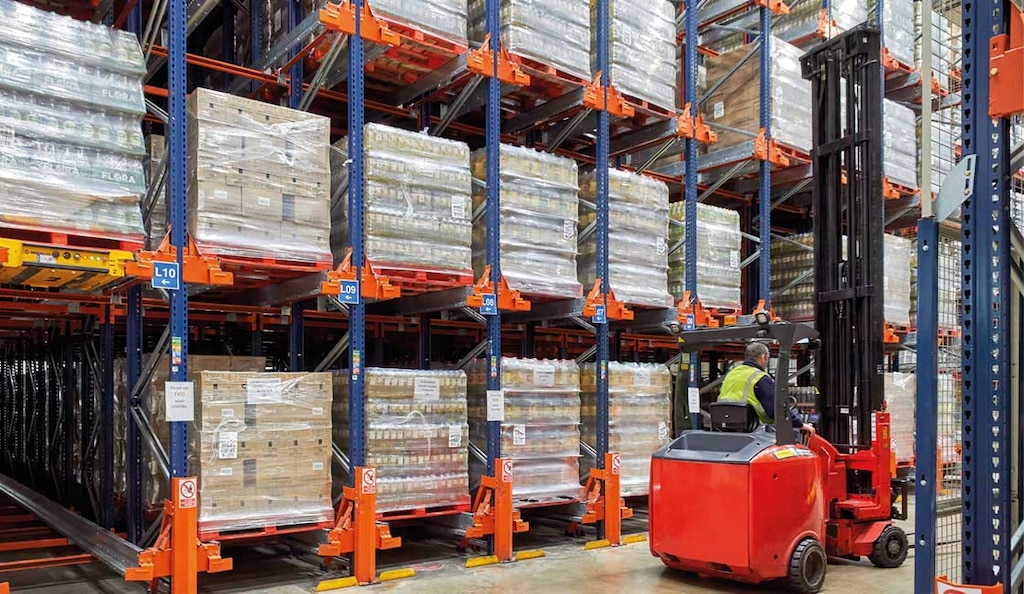
A forklift load chart explained
Below is an example of how to read a chart commonly found on forklift data plates:
| Lift height | Load center | |
|---|---|---|
| 20" | 24" | |
| 256" | 3,362 lb | 3,142 lb |
| 146" | 3,803 lb | 3,417 lb |
The table is organized along two axes:
- Rows: Lift height (in inches for our example).
- Columns: Distance between the mast and the forklift load center in inches, indicating how far the load extends beyond the forks.
Each cell shows the maximum allowable weight for a given combination. For example, at a lift height of 256" and a load center of 20", the maximum permitted load is 3,362 lb. The load center is typically located at the midpoint of a uniformly distributed pallet load. If the actual load center does not match the values shown in the table exactly, operators should use the most conservative value available — that is, the one corresponding to the lower capacity — to maintain an appropriate safety margin.
Suppose a pallet weighs 3,307 lb. To determine whether it can be handled safely, the first step is to consider its position on the forks.
- If the forklift load center is 20", the pallet can be lifted to either 256" or 146" since the maximum capacities (3,362 lb and 3,803 lb, respectively) exceed the pallet’s weight.
- If the load center is 24", the pallet cannot be raised to 256" because the maximum capacity under those conditions is only 3,142 lb, which is less than the pallet’s weight. However, it can be lifted to 146", where the maximum capacity reaches 3,417 lb.
This example illustrates how the same load may be safe or unsafe depending on both its position on the forks and the height to which it is lifted.
In daily operations, checking the forklift data plate is standard practice, especially when working at greater heights. The nameplate serves as a visual reference that helps operators avoid maneuvers that could compromise stability.
Forklift safety in the warehouse
A forklift capacity chart is a critical reference for warehouse personnel. However, it’s only one element of a broader strategy to optimize warehouse performance. Safe forklift operation also depends on practices such as conducting pre-shift inspections, always wearing a seat belt, never transporting passengers, and following facility speed limits.
Many companies complement these measures with technology designed to lower operational risks. A warehouse management system, for example, can record the weight of pallets as they arrive at the facility. Interlake Mecalux’s Easy WMS cross-references this information with equipment capabilities and available storage locations to prevent loads from being assigned to areas where operating limits could be exceeded.
In most warehouses, inbound goods are already adapted to the facility’s requirements and the capacity of the available equipment. Even so, many forklifts incorporate integrated weighing systems that display load weight in real time. This allows operators to verify that each load remains within approved limits.
Warehouse safety can also be enhanced through partial automation. One example is replacing drive-in pallet racking — which requires forklifts to enter storage lanes — with systems such as the Pallet Shuttle. This solution uses an autonomous motorized shuttle to move pallets within the rack structure, eliminating the need for forklifts to travel inside the lanes.
Another effective option involves replacing operator-driven trucks with automated trilateral stacker cranes, particularly in facilities already operating with narrow aisle forklifts. These machines perform storage and retrieval tasks autonomously, without direct operator involvement. Such systems can serve as an intermediate step toward full warehouse automation, which minimizes errors and optimizes logistics performance. This can be achieved by implementing automated storage and retrieval systems (AS/RS) such as the 3D Automated Pallet Shuttle, conveyors, and autonomous mobile robots (AMRs).
Beyond the forklift capacity chart: Ensuring safe operations
A forklift capacity chart is an indispensable tool for safe material handling in warehouse environments. Its effectiveness depends on accurate interpretation and consistent use during every lifting operation. Understanding how factors such as lift height and forklift load center affect capacity helps operators make informed decisions and avoid unnecessary risks. The chart should be supported by employee training, digital tools, and solutions that limit manual intervention where appropriate. Together, these measures create safer workplaces while enabling facilities to meet the demands of modern logistics.