



Data flywheel: Definition and turning it into a competitive edge
A data flywheel converts information into a continuous growth engine. Companies now generate more data than ever from operations, clients, and internal workflows. And every digital interaction leaves a trace. The real question is no longer whether data exists, but how it can deliver value.
While the flywheel concept appears in several fields — including marketing — this post focuses on its application in operations and process contexts. It pays special attention to data-rich sectors like manufacturing and logistics.
What is a data flywheel and how does it work?
A data flywheel is a model in which collecting, processing, and using information creates a continuous feedback loop. The idea is straightforward: data optimize processes, which yield higher-quality information, and then that knowledge drives further gains. Over time, this virtuous cycle builds momentum.
Ultimately, a data flywheel operates like a physical one. At first, it calls for considerable effort to get moving. As information flows and processes stabilize, the system gains traction. Eventually, each cycle reinforces the next, leading to stronger outcomes.
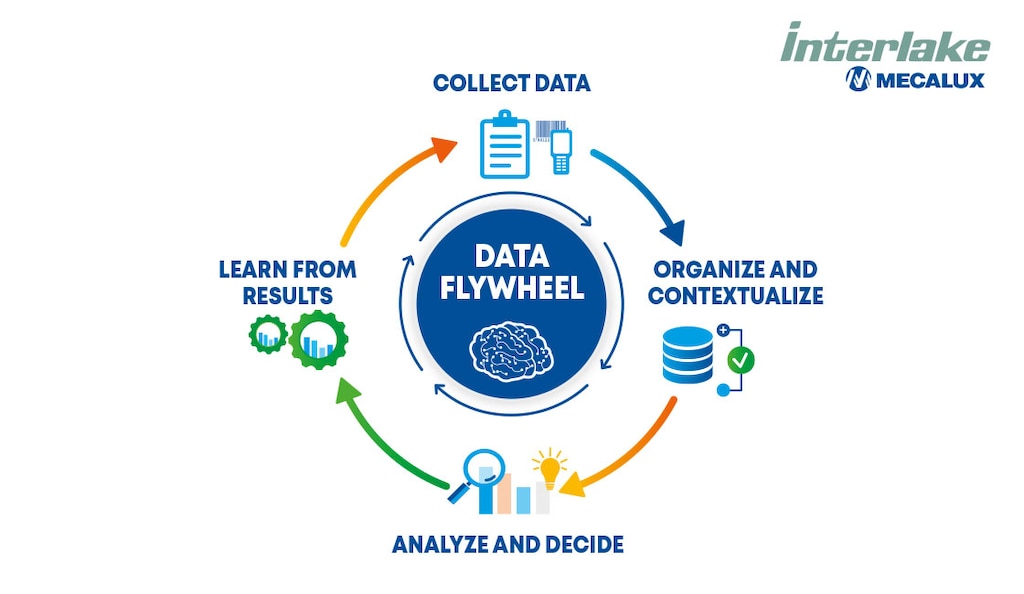
In a business setting, a data flywheel typically follows four steps:
- Collect data. Systems, sensors, and applications log daily activity.
- Organize and contextualize. Records are structured for effective processing.
- Analyze and decide. Once the data are integrated, patterns, deviations, and trends emerge, enabling process adjustments and more accurate decisions.
- Learn from results. Outcomes generate new inputs, making the system smarter in subsequent cycles.
Origins of the flywheel model
Jim Collins popularized the flywheel concept in his business management book Good to great: Why some companies make the leap … and others don’t (2001). Through an extensive comparative study, he identified the factors that enable organizations to achieve sustained high performance over time.
Collins’ research showed that the flywheel is an accumulative process: each effort builds on the last until it gathers momentum that’s hard to stop. Rather than a sudden shift, the flywheel effect reflects steady progress that, as it gains inertia, transforms organizational performance.
Amazon later demonstrated how technology amplifies this effect. More customers led to more transactions, which produced more data; that information then enhanced the user experience, attracting even more customers. The loop kept reinforcing itself.
In marketing, HubSpot reframed the concept of the flywheel as an alternative to the traditional funnel, placing the customer experience at the center. Instead of ending with a sale, the cycle relies on satisfied clients who promote the brand and create new opportunities.
Applications and examples of a data flywheel
A data flywheel adapts to any sector with a steady flow of information and the analytical ability to turn it into action. The principle is simple: more relevant data increase process performance, and better processes lead to more precise insights. Today, the AI data flywheel takes this further, with algorithms learning from each interaction and refining outputs over time to raise system quality.
Manufacturing and predictive maintenance
In industrial settings, IIoT sensors track vibration, temperature, cycle times, and energy use. These inputs feed predictive models that anticipate failures and adjust production parameters.
Each data-driven intervention produces new records on performance, deviations, and response times. The result is a flywheel that minimizes unplanned stoppages and maximizes overall equipment effectiveness (OEE). Over time, businesses build operational knowledge that’s difficult to replicate.
Energy and smart grids
The energy sector offers strong examples of flywheel data management in action. For companies like Iberdrola Group, the millions of sensors across their infrastructure provide vast amounts of daily data.
This information supports maintenance planning, demand forecasting, and climate scenario modeling. Each improvement creates additional data that enrich predictive models. As a result, the data flywheel enhances both efficiency and foresight by leveraging exclusive, real-time data.
Healthcare and digital twins
In the medical sector, digital twins enable a data flywheel focused on clinical and operational simulation. Siemens Healthineers, for example, has developed virtual replicas of 130 hospitals by combining operational data with anonymized records.
Each simulation improves the precision of diagnostic and planning algorithms. As the system learns, recommendations become more accurate, producing new structured clinical data that feeds the cycle.
Digital platforms and learning economies
Digital platforms act as natural accelerators of the data flywheel. Services like Netflix and Spotify refine recommendations with each interaction.
Every click, pause, and rating provides context that trains algorithms. As recommendations improve, engagement grows, generating even more data. This ongoing learning loop strengthens the system over time.
Logistics and warehouse management
Logistics environments are ideal for building a strong data flywheel. A digital warehouse churns out constant real-time information on locations, picking times, inventory turnover, incidents, and demand patterns. When companies apply structured analysis, these data support slotting optimization, resource planning by season, route redesign, and scenario simulation.
Each adjustment creates new records that improve data quality. Promotional campaigns, product changes, and demand shifts add further context, transforming daily operations into a continuous source of learning.
Here, the cycle becomes clear: better data lead to stronger decisions, which refine processes and generate even more reliable inputs. Over time, this mechanism becomes a strategic asset that strengthens supply chain competitiveness and resilience.
The flywheel doesn’t just depend on data volume but on the ability to capture, integrate, and convert them into decisions. This is where automated storage solutions and a warehouse management system (WMS) make a difference. A WMS integrated with ERP software and connected to automation acts as a hub for operational learning, turning information into increasingly accurate decisions across a unified digital ecosystem.

How to build a data flywheel
Implementing a data flywheel means designing a system where information fuels continuous learning. Key steps include:
- Digitalize processes. Capture data consistently across key operations to build a reliable information base.
- Integrate and govern data. Connect business systems and define quality standards so data can be analyzed as a whole.
- Enrich and add context. Include variables that explain what happened and under which conditions (volume, seasonality, resources, product types, etc.).
- Apply advanced analytics and AI. Convert data into predictive insights to identify patterns and support better decisions.
- Move toward simulation and connected ecosystems. Incorporate digital twins and integrated platforms to expand learning and strengthen competitive advantage.
When these elements work together, the system becomes more than technology — it becomes a strategic lever for continuous improvement. In logistics, for instance, operational data analysis can reveal inefficiencies, anticipate demand shifts, optimize processes, and generate new insights that sustain the learning cycle.
The strategic importance of a data flywheel
The value of a data flywheel lies in its cumulative effect. Every recorded activity, interaction, and adjustment strengthens the system. When management platforms and technological tools work together seamlessly, companies gain more than efficiency — they build a structural advantage rooted in proprietary knowledge. This asset is hard to replicate and grows stronger over time. In competitive markets where adaptability defines success, transforming data into a continuous learning loop is no longer optional. It’s a strategic decision.