


Split case picking: How to organize it to optimize order fulfillment
Split case picking is an order fulfillment method in which individual items are retrieved to assemble orders made up of loose units. Its popularity has grown alongside the rise of ecommerce, and there are several ways to implement it. Companies should assess each option carefully, since the strategy they choose will have a direct effect on order accuracy and, ultimately, customer satisfaction. In this post, we explain what split case picking is, which systems are commonly used, and why having the right warehouse management system in place is essential before getting started.
What is split case picking?
Split case picking — also known as piece picking, each picking, and broken case picking — is a logistics process that involves selecting products one by one to assemble a specific customer order. It focuses on handling items at the unit level rather than full cartons. While some operations rely on picking complete cases, this approach is widely used by companies that manage broad product assortments and high order volumes, such as ecommerce and retail businesses. Because it directly affects delivery speed and reliability, split case picking plays a critical role in logistics performance and the overall customer experience.
Split case picking vs. case picking
With split case picking, items are selected individually to fill outgoing orders. Case picking, by contrast, involves retrieving full cartons rather than single product units. As a result, split case picking is usually more complex and resource-intensive. Many supply chains combine both methods. A distribution center may replenish retail stores with full cases while fulfilling online orders through split case picking for end consumers.
Split-case order picking systems
There are several ways to organize split case picking, ranging from fully manual processes to highly automated solutions. To choose the right approach, companies must balance initial investment, shipping speed, and the ability to scale as demand fluctuates.
Manual split case picking
In manual setups, warehouse associates pick individual items from storage locations following tasks generated by a warehouse management system (WMS). This person-to-goods model can be improved with technologies that minimize travel time and picking errors. Common tools include RF scanners, pick by voice (using spoken instructions), and put/pick-to-light systems, which are installed on shelving units to guide associates visually without paper lists. Autonomous mobile robots (AMRs), like our AMR 100 Multi-Box model, further streamline the process by transporting totes and handling travel between aisles; this allows workers to focus exclusively on item selection.
Other technology-driven strategies can also boost efficiency in manual split case picking. For instance, batch picking groups items from multiple orders on a single run, while wave picking organizes work according to routes, carriers, or priorities.
One particular advantage of manual split case picking is its flexibility when managing diverse SKUs. However, productivity may decline when order volumes surge, largely due to the extensive travel time required.
Automated split case picking
Using automated storage and retrieval systems (AS/RSs) for split case picking enables faster, highly accurate order fulfillment. The key benefit lies in removing warehouse associate travel, as goods move automatically from storage to dedicated pick stations. Within this environment, two main models exist, depending on who performs the final pick: goods-to-person and goods-to-robot.
Goods-to-person split case picking
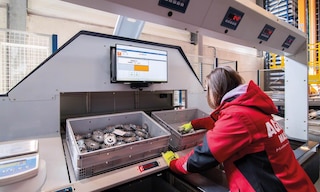
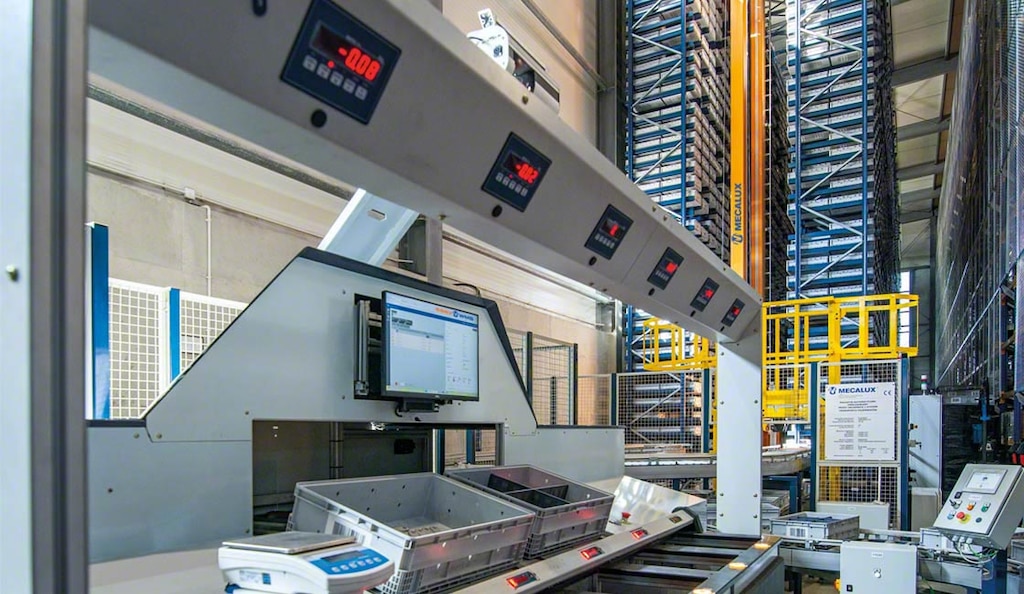
With the goods-to-person technique, machines deliver products directly to operator workstations. In mini-load systems (AS/RSs for boxes), totes and trays are conveyed to pick stations automatically. These terminals can also be high-performance pick stations, designed to provide immediate access to a large number of totes or trays.
To speed up split case picking, several technologies can automate goods flow. Mini-load systems offer high-density storage, while the Shuttle System increases throughput by using independent transfer cars on each level to multiply retrieval cycles. AMRs add even more flexibility depending on the unit load type. Rack-based models can move entire shelving units to workstations, creating shelf-to-person systems. Box-handling AMRs replace fixed conveyors by transporting individual totes or trays from storage to pick stations. Together, these technologies allow companies to scale automation in line with operational needs, ensuring each box or shelf arrives exactly when needed and with minimal effort.
Although this approach requires a higher upfront investment than manual picking, goods-to-person split case picking delivers major strategic benefits. These include a sharp increase in productivity and optimal use of available space through vertical, high-density storage. Accuracy also improves significantly, as the WMS coordinates machine movements and guides associates via screens or lights, reducing the risk of errors. Beyond handling higher demand peaks, goods-to-person split case picking enhances workstation ergonomics and lowers costs linked to reverse logistics operations.
Goods-to-robot split case picking
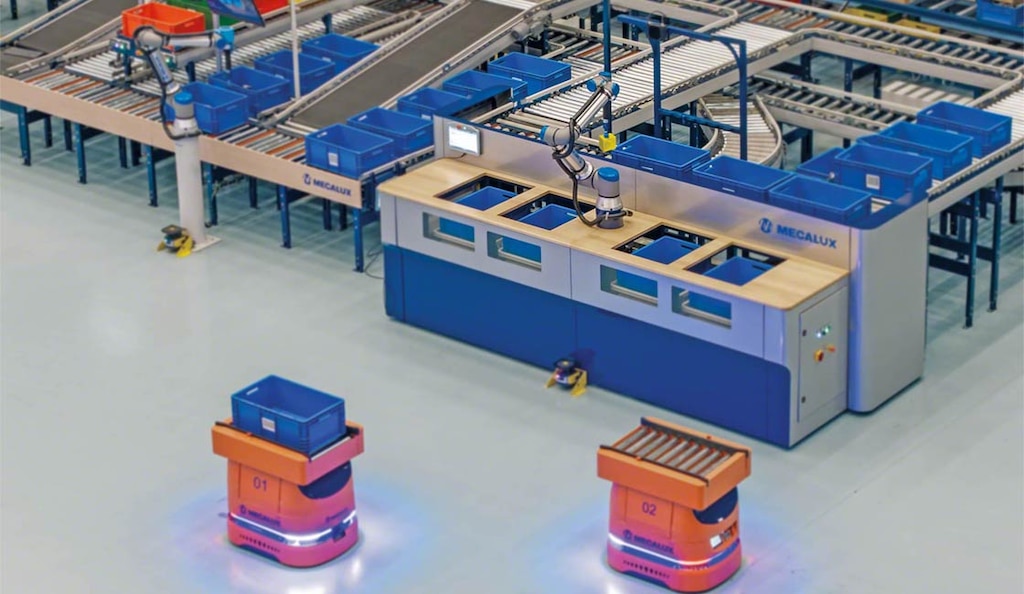
Piece picking can also be performed without direct human involvement through the goods-to-robot system. With this method, AS/RS solutions deliver unit loads to a station where a picking robot or collaborative robot (cobot) removes individual units and places them in an order box. The most sophisticated cobots rely on vision software powered by deep learning algorithms to identify and handle products with varying shapes, surfaces, and dimensions.
How to choose the right split case picking strategy
Selecting the most suitable approach depends on several factors, such as daily order volume, SKU count, and available warehouse space. To achieve maximum efficiency, the method should align with each company’s operational profile. When scalability and long-term performance are priorities, automation often proves the most strategic choice. Below are examples of how different businesses have implemented split case picking:
- Manual split case picking. At Caffè d’Autore’s warehouse in Barcelona (Spain), associates fill orders averaging 15 lines by following instructions from Easy WMS. The software optimizes travel by identifying exact locations and quantities for picking. After orders are individually packaged and labeled, Easy WMS organizes them by destination — customers or service vans. Moreover, it supports efficient weekly replenishment based on minimum and maximum inventory levels.
- Semi-automated split case picking (person-to-goods). In Chanteloup-en-Brie (France), AS Healthcare uses conveyors and carton flow racks outfitted with a pick-to-light system. Visual indicators show warehouse associates where to pick SKUs and how many units to retrieve.
- Automated split case picking (goods-to-person). Polish agricultural manufacturer Agro-Masz installed a Mecalux Group mini-load system, complemented by a high-performance pick station at one end. This upgrade significantly increased order fulfillment throughput.
The role of a WMS in optimizing split case picking
To coordinate split case picking effectively — whether in person-to-goods setups or highly automated goods-to-person environments — implementing WMS software is vital. Acting as the warehouse mastermind, a WMS provides multiple benefits:
- Person-to-goods. Through intelligent warehouse slotting, software solutions such as Easy WMS position SKUs based on turnover and optimize pick paths to reduce travel. Additionally, real-time task synchronization coordinates picking assistance devices, guaranteeing smooth, accurate operations.
- Goods-to-person. The WMS sequences case flows from storage, ensuring items reach pick stations in the correct order. It also manages dynamic order prioritization, automatically reshuffling tasks in response to last-minute demand changes or time-critical deliveries. This level of responsiveness is something manual processes cannot match.
Split case picking: A strategy worth considering
In the end, successful split case picking comes down to matching the operation to each company’s order volume and specific needs. To determine how much technology the process requires, defining the right operational scale and understanding SKU complexity are the best starting points. From there, automated models coordinated by robust split-case picking software offer a reliable way to transform complex workflows into scalable, accurate operations that can keep pace with market demands.