



ABC XYZ analysis: Pros and cons
ABC XYZ analysis classifies products by their value in addition to the variability and predictability of their demand. This approach makes the matrix a useful tool for improving operational efficiency. Beyond considering an item’s consumption value, it’s essential to account for demand when prioritizing goods. Only then can companies devise replenishment strategies that minimize the risks of overstock or stockouts.
In this post, we explore what ABC XYZ analysis is, its advantages and drawbacks, how it’s calculated, and its connection to warehouse management and demand planning.
What is ABC XYZ analysis?
ABC XYZ analysis is a classification technique that combines two complementary approaches to segment inventory. ABC analysis focuses on the annual consumption value for each SKU, while the XYZ model evaluates the stability or predictability of demand. By crossing these two criteria, businesses obtain a nine-cell matrix that helps prioritize products and develop procurement policies tailored to actual inventory behavior.
This nine-cell ABC XYZ matrix is commonly used by demand planners to formulate strategies and make informed decisions about product assortment and inventory control.
In practice, ABC segmentation organizes products by economic impact: A-items represent the largest share of annual consumption value, followed by B and C. XYZ analysis groups items according to demand stability: X-products exhibit consistent, predictable demand; Y-items show moderate variations; and Z-products experience irregular or hard-to-forecast demand.
Unlike the ABC method alone, ABC XYZ analysis incorporates crucial additional data that support inventory optimization and help prevent stockouts. While ABC centers on a single criterion — such as sales volume, revenue, or value — ABC XYZ provides a more complete perspective by including demand volatility and uncertainty. In other words, it factors in the risk associated with managing a certain product.
ABC XYZ analysis: Positives and negatives
ABC XYZ inventory analysis helps companies plan their product assortment effectively by allowing them to prioritize resources. It facilitates decisions on storage space for different products based on value as well as risk, while enabling suitable inventory policies. However, the method comes with both benefits and limitations:
- Inventory optimization. By identifying the most critical products, ABC XYZ analysis helps maintain ideal inventory levels and ensures high-priority items remain available.
- Pricing strategy. With insights into product value and demand, category managers can set prices more effectively and maximize margins.
- Opportunities for improvement. The technique highlights items that require attention, supporting decisions related to suppliers, supply chain processes, or similar products.
ABC XYZ limitations are primarily related to market dynamics and the need for historical data. This technique can only be applied to items with sufficient demand history to calculate volatility, making it unsuitable for new products. Moreover, it doesn’t account for correlations between items or other events that could affect demand, so companies have to adjust the results using market knowledge.
How to calculate ABC XYZ
ABC XYZ analysis categorizes SKUs into three classes over a defined period. Typically, A represents the most profitable items, B intermediate products, and C the least valuable. The additional XYZ classes measure demand variation over a given period. X includes products with stable demand, Y moderately stable, and Z highly fluctuating demand.
Once the ABC analysis is complete, the next step in ABC XYZ is to determine the demand variability for each product.
Demand variation formula
To calculate demand variability, divide the standard deviation by the average demand to obtain the coefficient of variation (CV). This metric is used to analyze and compare demand stability.
CV = Standard deviation / Average demand
Average demand is calculated using the mean consumption or sales per product over the defined period.
Standard deviation is calculated as follows:
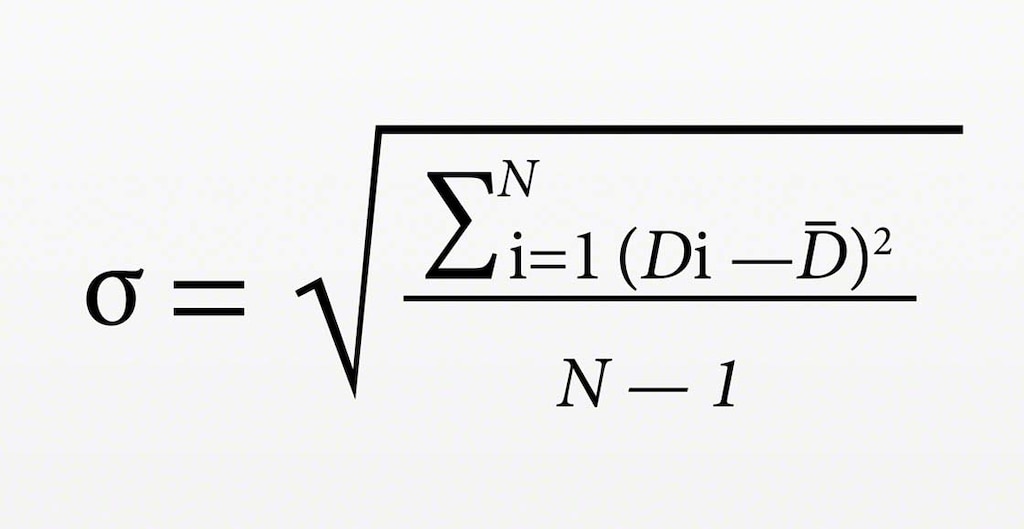
Where:
- Di is the demand for each individual period.
- D is the average demand, calculated by dividing the total demand by N.
- N is the total number of periods analyzed.
- N-1 serves as the denominator when calculating the standard deviation for a sample.
To simplify this task in Excel, apply the =AVERAGE(data_range) function to determine the average demand and =STDEV.S(data_range) for the standard deviation. Next, obtain the coefficient of variation (CV) with the formula =Standard_Deviation_Cell / Average_Demand_Cell. Finally, format the CV result as a percentage.
The ABC XYZ segmentation matrix
Creating the ABC XYZ segmentation requires three steps: prepare the ABC segmentation, the XYZ segmentation, and then combine them into a final nine-cell matrix.
- ABC analysis (vertical axis). Based on the value or volume of demand, this involves organizing items according to their economic impact on inventory.
- XYZ analysis (horizontal axis). This refers to the stability or variability of demand. The main criterion is the coefficient of variation, which determines whether demand variability is low (stable and predictable), medium (subject to seasonal fluctuations), or high (erratic and irregular).
- Next, the final segmentation matrix is prepared in a three-by-three grid. Each of the nine cells groups items corresponding to that combination. Some products are high-value with more predictable demand (AX), while others are less profitable and exhibit more erratic demand (CZ).
| A | B | C | |
|---|---|---|---|
| X | High demand, stable | Medium demand, stable | Low demand, stable |
| Y | High demand, moderately variable | Medium demand, moderately variable | Low demand, moderately variable |
| Z | High demand, irregular | Medium demand, irregular | Low demand, irregular |
XYZ model calculation: A practical example
First, demand data are collected over a defined period. For this example, we’ll examine Product 1 and Product 2 across five distinct periods.
| Period (N = 5) | Product 1 demand (Di) | Product 2 demand (Di) |
|---|---|---|
| 1 | 95 | 50 |
| 2 | 105 | 200 |
| 3 | 100 | 100 |
| 4 | 90 | 150 |
| 5 | 110 | 0 |
| Total demand | 500 | 500 |
| Average demand (D) | 500/5 = 100 | 500/5 = 100 |
Since both products have the same average demand, it’s necessary to calculate their variability to compare them. To do this, we use the standard deviation formula:
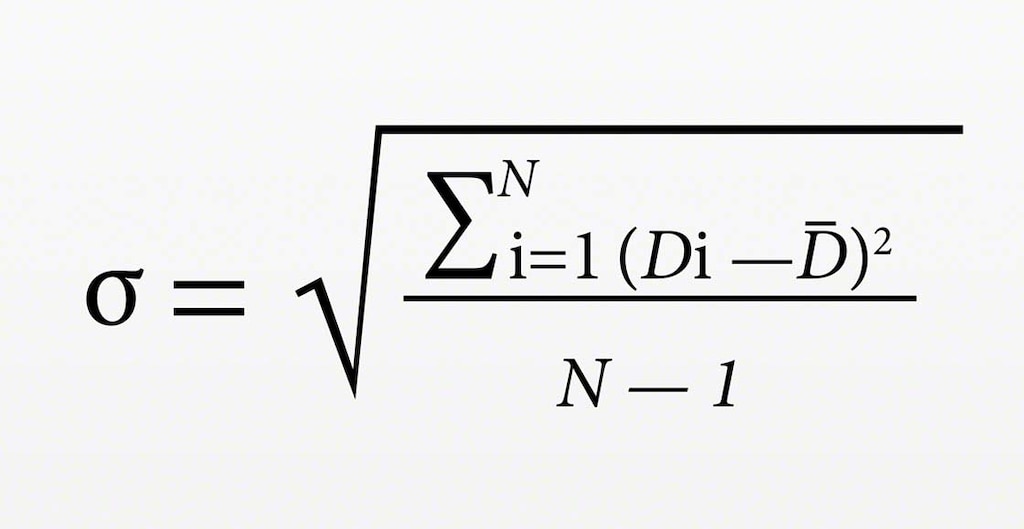
- The standard deviation for Product 1 is 7.91, while for Product 2 it’s 79.06.
Next, we calculate the coefficient of variation (CV):
CV = Standard deviation / Average demand
- Product 1 CV: 7.91 / 100 = 0.0791 x 100 = 7.91%
- Product 2 CV: 79.06 / 100 = 0.7906 x 100 = 79.06%
Once the CV is calculated, each item is assigned to the previously defined XYZ thresholds. There’s no single criterion for setting these limits; they’re adapted to each company. That said, these are the most common values:
| Category | Coefficient of variation (CV) |
|---|---|
| X | CV ≤ 10% |
| Y | 10% < CV ≤ 25% |
| Z | CV > 25% |
If we assume that Product 1 and Product 2 fall into Class A under the ABC analysis, and we apply the most typical XYZ thresholds, their ABC XYZ segmentation would be as follows:
| Product | Average demand | Value (ABC) | CV | Stability (XYZ) | Final classification |
|---|---|---|---|---|---|
| 1 | 100 | A (High) | 7.91% | X (Stable demand) | AX |
| 2 | 100 | A (High) | 79.06% | Z (Highly volatile demand) | AZ |
ABC XYZ and warehouse efficiency
The ABC XYZ model closely relates to warehouse organization. Employing slotting strategies in line with this matrix, companies can position high-demand products in easily accessible locations.
A warehouse management system (WMS) places class-A items near picking or shipping areas, while class-C items go to more distant or less ergonomic zones. By concentrating A-items in high-density areas, a WMS like Interlake Mecalux’s Easy WMS generates the shortest order picking routes. This logistics software can rely on advanced modules such as Slotting for WMS, which optimizes storage locations and updates them based on each product’s historical, current, and projected demand. XYZ classification further improves placement decisions by factoring in demand stability.
ABC XYZ and demand planning
Effective ABC XYZ analysis depends on meticulous demand planning, as both value (ABC) and variability (XYZ) are derived from historical sales data. Combining these variables defines the best inventory strategy for each product as well as safety stock levels.
Classifying SKUs by both value and demand volatility helps prioritize resources, make better supplier decisions, and strengthen overall supply chain management.
ABC XYZ in 5 questions
What is ABC XYZ analysis in inventory management?
ABC XYZ is a technique used to categorize products based on their demand and business relevance. It combines XYZ planning with ABC inventory classification, producing a nine-cell matrix.
How does ABC XYZ differ from ABC?
ABC uses a single criterion, usually profitability based on annual consumption. ABC XYZ adds the layers of demand uncertainty and volatility, assessing the risk of managing each item type.
What is demand variability?
Demand variability measures fluctuations in customer demand over time, showing how much actual demand deviates from expected or forecast levels.
What are the pros and cons of ABC XYZ?
This technique optimizes inventory levels (ensuring key products are available), facilitates pricing decisions, and highlights improvement opportunities. Limitations include the need for sufficient historical data (making it unsuitable for new products) and the method’s inability to consider external events or correlations between products.
When is XYZ planning recommended?
XYZ planning is recommended for items with enough of a demand history to calculate volatility, enabling resource prioritization. Products are classified from stable (X) to highly variable (Z), guiding storage space allocation and inventory policies.