


A study analyzes the benefits of combining the two technologies to streamline logistics processes

LOGISTICS RESEARCH
By Pahune, S. A., Akhtar, Z., Chandrasekharan, M., Yadav, S. S., and Siddique, K.
What happens when generative artificial intelligence (GenAI) is combined with robotic process automation (RPA) in the supply chain? A study suggests that integrating these two technologies could reduce errors and improve companies’ ability to adapt to constantly changing environments.
Few business functions have been transformed as much by recent technological advances as supply chain management. One of the most widely adopted solutions is robotic process automation (RPA). This software executes repetitive, seemingly simple tasks such as connecting to web applications, creating directories and folders, and copying, pasting, and renaming files.
Applied to logistics, RPA technology can update inventory records, track shipments in real time, and extract information from data available on supplier websites. However, RPA also has limitations. It relies on predefined rules and cannot learn from new situations or make complex decisions without prior instructions.
To give software systems greater analytical and decision-making capabilities, the researchers propose taking automation a step further by integrating RPA with cognitive systems and generative AI. According to their study, this combination could automate tasks, improve decision-making, and predict future scenarios more accurately.
“Generative AI has impacted many different industries. When integrated with RPA, it could help build enhanced automation systems with exceptional adaptability. In addition, various GenAI models can reinvent the supply chain optimization process in the future,” say the researchers.

How do RPA and GenAI work together?
According to the proposed model, combining generative AI with RPA starts by automating routine business processes. Software bots handle repetitive tasks — such as processing invoices or updating purchase orders — while collecting data from multiple sources, including contracts, invoices, and customer interactions.
The information obtained is transferred to a vector database, a type of repository that enables GenAI to quickly retrieve the most relevant information from large volumes of documents. The AI then accesses up-to-date operational data and utilizes them to answer user queries submitted through a virtual assistant. When users ask about orders, shipments, or returns, the system retrieves the data collected by the bots and generates a natural-language response.
RPA bots execute tasks and generate data that GenAI analyzes to respond to users
The vector database is continuously updated with new information generated by automated processes. According to the researchers, this approach combines the efficiency of process automation with the analytical capabilities of AI, streamlining everything from customer service and document management to operational planning across the supply chain.
A combination that optimizes processes
According to the researchers, integrating generative AI with RPA adds an intelligence layer to process automation, enhancing decision-making across the supply chain. While RPA automates tasks and executes actions automatically, GenAI analyzes information and helps anticipate scenarios:
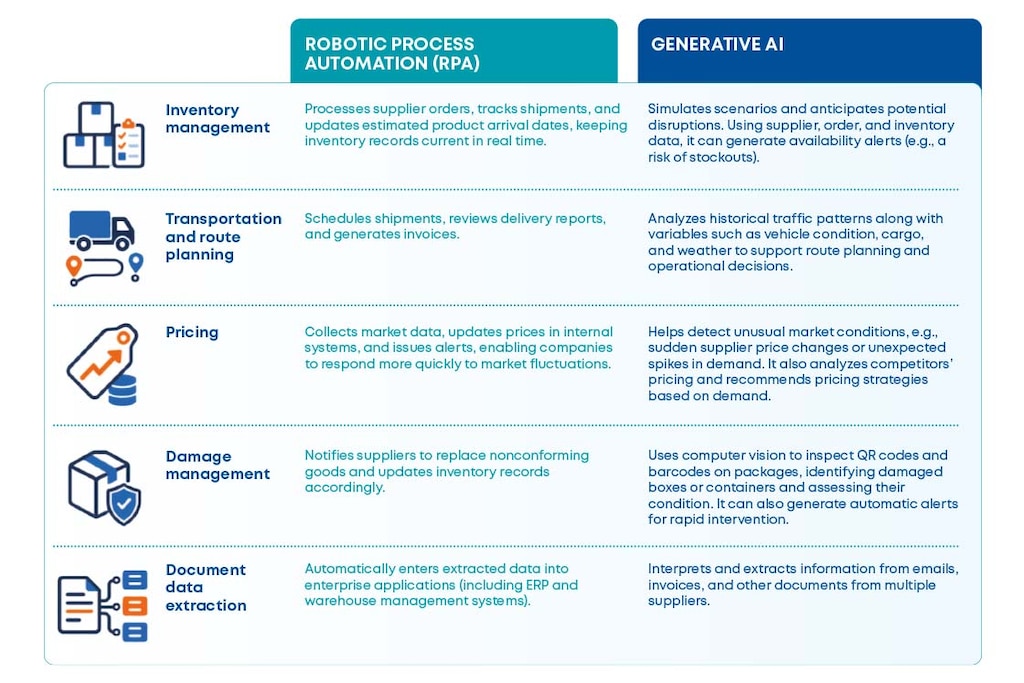
While RPA automates tasks, GenAI analyzes information and helps anticipate potential disruptions
Challenges and opportunities
The researchers agree that generative AI and robotic process automation can complement each other effectively. However, they also acknowledge that integrating them is not always straightforward. RPA systems are typically designed to perform structured, rule-based tasks, whereas GenAI works with more dynamic, unstructured data. In addition, the two technologies often rely on different programming languages and data formats, requiring integration tools capable of connecting disparate architectures. Other challenges include the need for IT infrastructure, cloud services, software licenses, and skilled professionals.
Despite these hurdles, the researchers contend that combining generative AI and RPA could represent a major step forward in optimizing supply chain management. “This approach enhances flexibility and enables the effective handling of large volumes of unstructured data, such as invoice processing, vendor contracts, complex document retrieval, inventory management, intricate customer interactions, and adaptability. It also promotes continuous learning, thereby strengthening supply chain management systems,” say the researchers.
Although technical and organizational challenges remain, integrating GenAI with RPA points to new ways of automating processes, analyzing information, and improving decision-making in increasingly complex logistics environments.
Authors of the research:
- Saurabh A. Pahune. Independent researcher (US)
- Zahid Akhtar. Assistant Professor, Department of Electrical and Computer Engineering, and Undergraduate Coordinator for the Cybersecurity Program, State University of New York Polytechnic Institute (US)
- Manoj Chandrasekharan. Researcher, University of Memphis (US)
- Shipra Shivkumar Yadav. PhD and Postdoctoral Supervisor, Lincoln University College (Malaysia)
- Kamran Siddique. Assistant Professor of Computer Science, University of Alaska Anchorage (US)
Original publication:
Pahune, S. A., Akhtar, Z., Chandrasekharan, M., Yadav, S. S., Siddique, K. Convergence of GenAI and RPA: A digital heaven in supply chain optimization process. Journal of Computer Science, 21(12), Pp. 3089–3112 (2025).