


LOGISTICS RESEARCH
By Alexandros Pasparakis, Jelle de Vries, and René de Koster
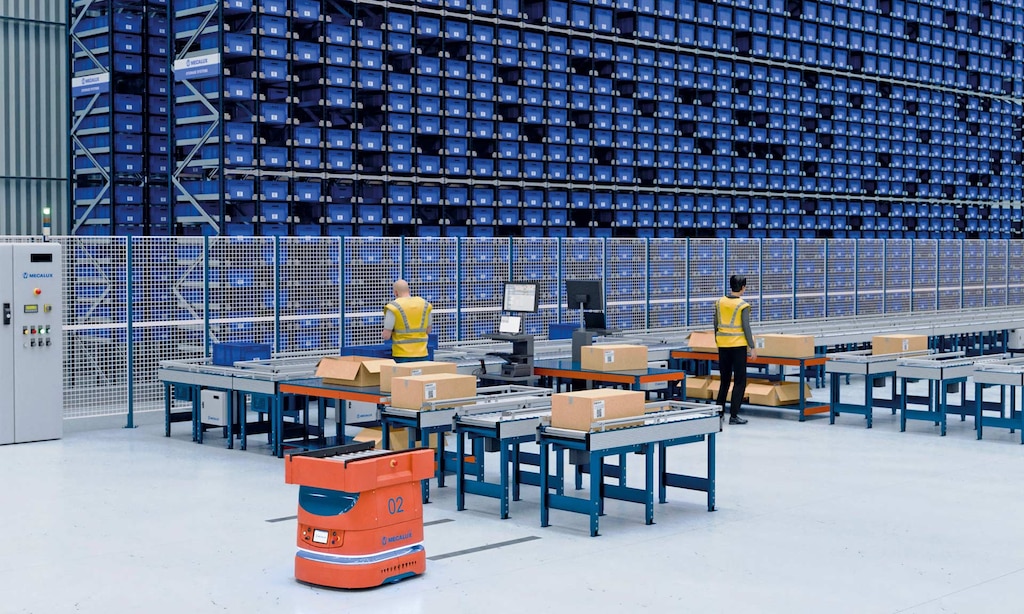
The latest generation of fully autonomous robots operates independently. They can explore, navigate, and manipulate their environment without human supervision. Advances in safe navigation, which allow these machines to move safely around people, are accelerating their adoption among warehousing service providers.
Humans increasingly work alongside autonomous robots in shared workspaces. This shift has led to the introduction of collaborative robots (cobots), designed to complement human labor rather than replace it. These dynamics are particularly evident in warehouses, where cobots assist workers with repetitive tasks such as load handling, enabling them to focus on more complex activities like order picking.
By delegating internal transport to robots, human pickers reduce travel, potentially making cobotic systems more productive than traditional order picking. One behavioral implication is that humans and autonomous mobile robots (AMRs) often alternate between leader and follower roles, depending on the task. Secondly, human behavior may be affected by prevention focus, a psychological construct that describes the level of vigilance individuals exercise in carrying out their responsibilities.
Active or passive role
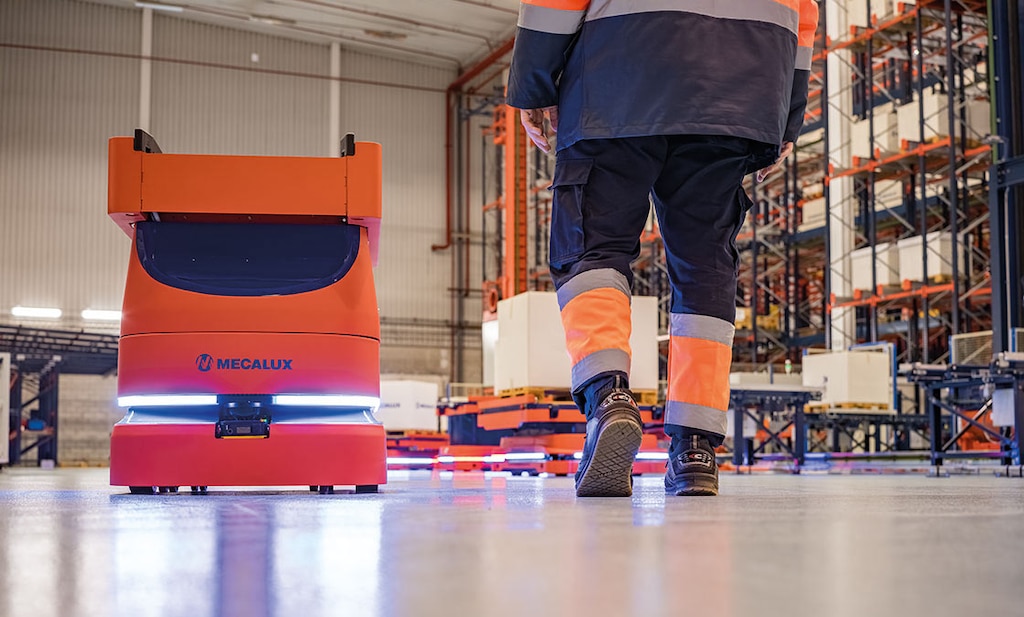
Under a collaborative model, the robot can now take the lead, placing people in either an active or passive role. In low-level person-to-goods order picking, certain types of cobots collaborate with warehouse associates. The machines adopt a leading or a supporting role, with pickers assuming the complementary one.
Freeing human workers from unnecessary travel can boost productivity in cobot-assisted picking
In a leading (active) role, cobots autonomously navigate to picking locations indicated by the warehouse management system. Subsequently, the picker interacts with the machine at the designated position, putting the requested item in the appropriate load carrier before following the cobot to the next pick location or searching for another AMR. In contrast, when pickers assume the active role, they navigate from one slot to the other, perform the pick task fed to them via voice picking or pick-to-light systems, and place the retrieved items on the robot, which follows closely.
Recent research argues that relieving warehouse associates of unnecessary travel can make cobot-assisted picking more productive than traditional order fulfillment.
The experiment
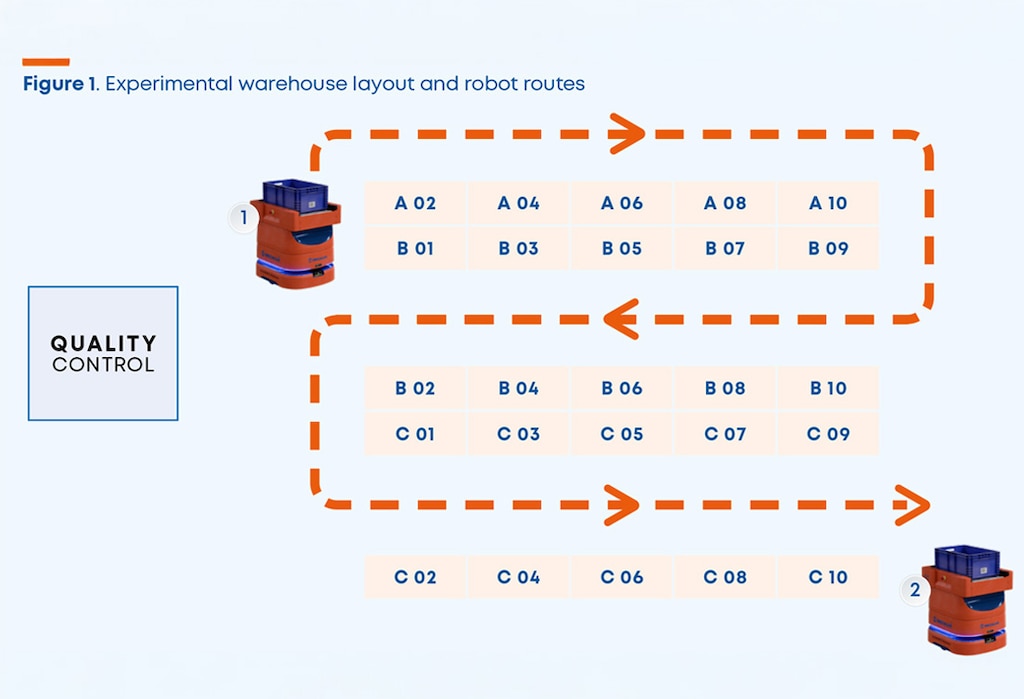
We designed and conducted a large-scale controlled physical experiment involving 60 participants, exposing them to scenarios in which either the human led the task or followed the robot. To accurately replicate the order picking process, we built a dedicated experimental warehouse with 300 pick locations in the Netherlands. The setup was designed to resemble a typical facility with picking shelves used worldwide to store small, low-volume items.
The participants were instructed to perform a simplified order picking task that can be summarized in four steps:
- Locate the next requested product on the order list.
- Pick the specified quantity and the item(s) in the order crate.
- Confirm the pick via the touchscreen interface.
- Repeat the process with the next order line until the order is complete; then proceed to the next available order.
We deployed two identical prototype AMRs, and orders were displayed to participants through a simple touchscreen interface. In the human-leading condition, the subject was informed that they were in control of the process, while the robot was there to support them by carrying the crate. Conversely, in the human-following setting, the robot navigated to the designated pick location, and the associate followed it there to perform the retrieval.
To maintain a continuous workflow, the endpoint of each order was positioned near the start of the subsequent one, allowing participants to move directly to a second AMR loaded with the next order. While the human fulfilled it, the first robot transported the crate to the quality control station without interfering with the picker’s or the second AMR’s movements. This eliminated unnecessary travel.
Performance vs. errors
To quantify real-world impact, we assume that the typical order picker works for six net hours per day and that they have immediate access to a new unoccupied robot as soon as they complete their previous order. We calculate three quantifiable advantages:
- The overall productivity advantage of the human-leading setup averages 8.3% more order lines per picker per day than the human-following scenario.
- Individuals with a high prevention focus can save an average of 21.7 minutes per day.
- In the human-following setup, the average picker makes 11.88 fewer errors per day.
Optimal configurations for each business
This study establishes that human-led collaboration between workers and robots yields a higher picking productivity. In contrast, when workers follow the AMR, picking accuracy improves, reducing errors by 0.66 every 20 minutes. Furthermore, we identify prevention focus — the level of vigilance individuals exercise in carrying out their duties — as the key human characteristic that partially explains productivity variations among workers. When following robots, high prevention-focused associates pick orders 40.1% faster than their low-prevention counterparts.
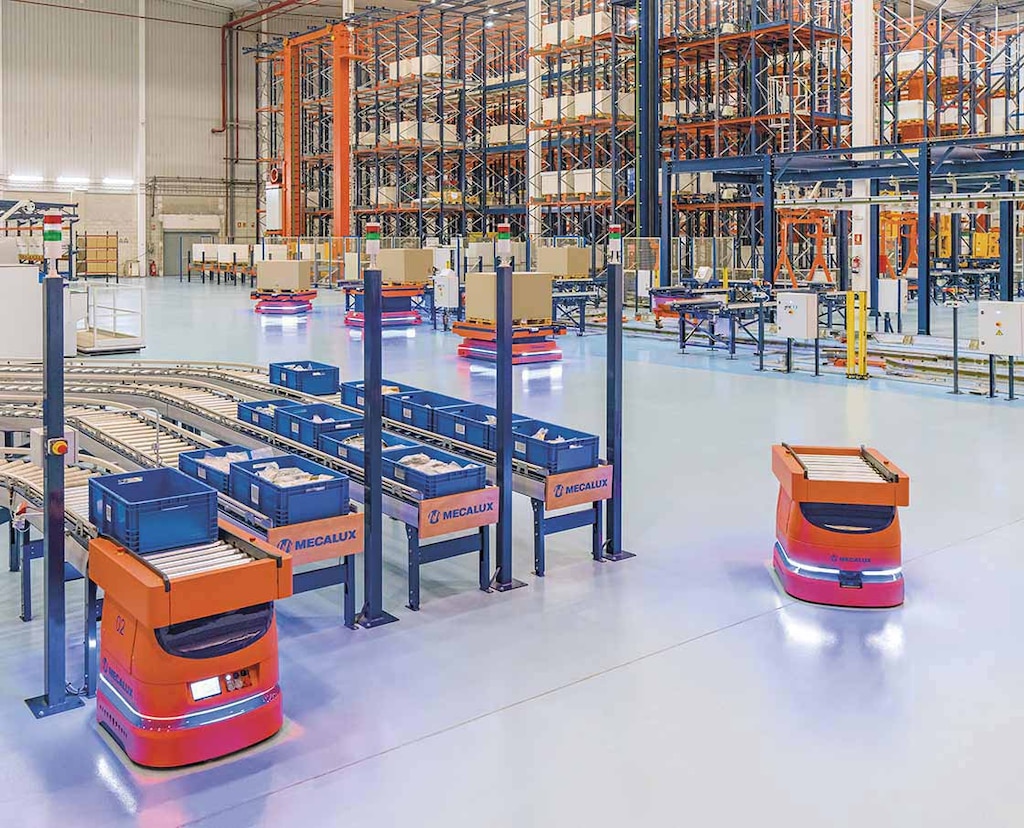
We demonstrate how perceived autonomy and task interdependence shape both productivity and accuracy. The human-leading configuration affords workers high decision autonomy over routing and pacing. Meanwhile, the human-following scenario imposes structured guidance, which mitigates cognitive load at the pick location and thus enhances accuracy.
Warehouses that require maximum throughput can benefit from the human-leading setup
When associates lead, productivity increases. As a result, facilities that prioritize throughput obtain substantial benefits with this configuration. On the other hand, if higher accuracy is needed (e.g., medicine, high-value products), a human-following scenario may be preferable for minimizing the risk of errors, even at the expense of higher throughput. Likewise, companies that incur high costs from picking errors may find robot-led collaboration to be the most cost-effective option.
One way to reduce the potential for errors in a human-led setup is to introduce quantity reminders or display that information when the associate reaches the pick location. Companies can also train workers to develop a higher prevention focus.
As robots become more autonomous, efficient, and competitive with manual tasks, they may pose a threat to parts of the workforce. However, the socially responsible alternative for Industry 5.0 dictates the need to focus on solutions that foster harmonious human–machine coexistence. The path to a sustainable future may lie in the synergistic collaboration between workers and robots.
AUTHORS OF THE RESEARCH:
- Alexandros Pasparakis. External PhD Candidate, Department of Technology and Operations Management, Rotterdam School of Management, Erasmus University Rotterdam (Netherlands)
- Jelle de Vries. Associate Professor of Operations Management, Tilburg University, Tilburg (Netherlands)
- René de Koster. Professor of Logistics and Operations Management, Rotterdam School of Management, Erasmus University Rotterdam (Netherlands)
Original publication:
Pasparakis, A., De Vries, J., De Koster, R.. In control or under control? Human–robot collaboration in warehouse order picking. Logistic Research. Emerald Publishing Limited (2026).
© 2026 The Authors. Published by Emerald Publishing Limited. Published under CC BY 4.0 license.