


Space logistics: What can companies learn from missions to the Moon and Mars?
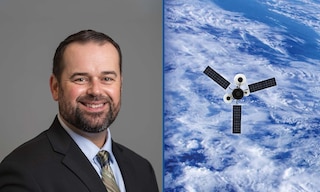
Interview with Kenneth O’Connor (University of West Florida)
Logistics research
Original publication: O’Connor, K. Interplanetary logistics: transportation challenges and supply chain lessons from space exploration. Transportation Journal, Vol. 65, issue 3. Wiley (2026).
“Reaching another planet is an extraordinary achievement. Staying there requires logistics,” says Kenneth O’Connor, Visiting Assistant Professor of Supply Chain Logistics at the University of West Florida. In this interview, the researcher explains why missions to the Moon and Mars provide an exceptional testing ground for rethinking the design of terrestrial supply chains.
-
What inspired you to explore interplanetary logistics?
The idea came from a simple observation: although often discussed as an engineering challenge, at its core, space exploration is also a logistics challenge. When we talk about sending humans to the Moon or Mars, we are really talking about building systems that can operate across enormous distances, with long delays, limited inventory, and almost no margin for error. Space missions force us to think differently about resilience, redundancy, sustainability, and autonomy. Interplanetary logistics is a fascinating lens for re-evaluating how we design supply chains on Earth.
-
How does the supply chain change for a journey to Mars, for instance?
When lead times are measured in months rather than days, planning becomes much more strategic and much less forgiving. The supply chain has to anticipate needs far in advance because there is no fast correction mechanism. Demand forecasting, inventory planning, maintenance scheduling, and risk assessment all become more important. On Earth, companies may tolerate some uncertainty because they can expedite shipments, switch suppliers, or use emergency transportation. In interplanetary logistics, those options are limited or unavailable. This requires a shift in how inventory is viewed: not simply as a cost but as a form of protection.
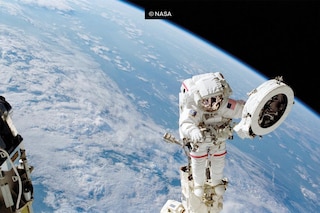
“Companies should invest in better predictive visibility to anticipate stress points before they become failures” -
What space logistics strategies can companies apply to their day-to-day operations?
Organizations can begin by designing for disruption rather than treating it as an exception. That means identifying the parts of the supply chain where failure would be most damaging and building redundancy around those areas before a crisis occurs.
Another principle is pre-positioning. Space missions require careful staging of supplies, spare parts, and equipment before they are needed. Terrestrial supply chains can apply the same logic by positioning critical inventory closer to points of use, especially in industries where delays carry high consequences.
A third principle is modularity. Space systems must often be repaired, replaced, or reconfigured under constrained conditions. Warehouses and transportation networks can benefit from the same mindset by using flexible systems, interchangeable components, and adaptable processes. Finally, companies should invest in better predictive visibility. The goal is not only to know where inventory is but to anticipate where stress points will appear before they become failures.
Space missions require systems that can function with limited human intervention, and that same capability is increasingly valuable in warehouses and commercial supply chains
-
Do you see any technologies developed for space exploration eventually being adopted in warehouses or commercial supply chains?
Yes. Autonomous operations are a clear example. Space missions require systems that can function with limited human intervention, and that same capability is increasingly valuable in warehouses and commercial supply chains. Autonomous mobile robots (AMRs), AI-enabled control towers, predictive maintenance systems, and digital twins all reflect this broader movement toward self-monitoring and adaptive logistics.
Closed-loop resource management is another critical area. In space, waste is not just inefficient; it is a threat to mission viability. That mindset can influence how warehouses and supply chains think about packaging, returns, energy use, repair, reuse, and material recovery.
-
In your research, you argue that sustainability takes on a completely different meaning in space. Why is that?
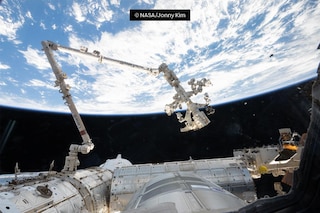
Organizations should design for disruption rather than treating it as an exception Sustainability becomes a matter of survival in space. On Earth, the concept is often discussed in terms of environmental responsibility, regulation, or corporate reputation. In space, sustainability is much more immediate. You cannot waste water, oxygen, energy, packaging, or material. That realization changed how I thought about closed-loop logistics. In extreme environments, sustainability and resilience are deeply connected. Systems that reuse more, waste less, and reduce their reliance on external replenishment can survive longer amid disruption.
-
What are the most valuable lessons logistics professionals can learn from space missions?
The most valuable lesson is that efficiency alone is not enough. Space logistics shows us that resilience must be designed into the system from the beginning.
I would emphasize four lessons that are also applicable to warehouses, transportation networks, military logistics, disaster response, and global supply chains. First, redundancy is not waste when failure is unacceptable. Second, closed-loop systems are essential because resources must be reused and regenerated. Third, autonomy matters, as real-time human control is not always possible. And fourth, hub-based networks can reduce risk by creating intermediate nodes for staging, storage, and redistribution.
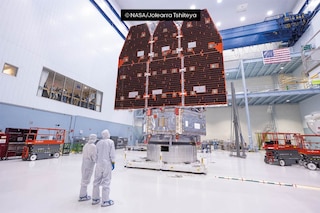
NASA technicians examine the Nancy Grace Roman Space Telescope after connecting its inner and outer sections -
What role will logistics play in future space exploration?
It will be a central enabler. We often think of exploration in terms of rockets, astronauts, and scientific discovery, but none of that is possible without logistics. Every mission depends on transportation, storage, resource allocation, maintenance, waste recovery, and resupply planning. As expeditions become longer and more ambitious, logistics will become even more crucial. A long-duration lunar base or Mars mission will need much more advanced logistics systems. These expeditions will require reusable transportation, local resource utilization, autonomous operations, and carefully designed supply hubs.
In many ways, logistics is what turns exploration from a single event into a sustainable presence. Reaching another planet is an extraordinary achievement. Staying there requires logistics.