



LOGISTICS RESEARCH
By Sebastian Schiffels and Christian Jost
Inventory management is where margins are won or lost. Deciding on the quantity and timing of each replenishment is a fundamental task traditionally performed according to so-called control policies. Nowadays, software providers offer user-friendly applications to manage inventory and apply these strategies in a standardized way. Companies often use these automated tools to control their inventory and thus their customers’ supply.
In contrast to the supply-oriented approach of inventory control, a common marketing practice is to limit supply to heighten customers’ desire and motivate them to buy promptly. To support this, many companies use modern IT tools and online platforms to provide customers with stock information, displaying real-time inventory. This creates a field of tension: while inventory management aims to balance ordering and holding costs under the assumption of external demand, marketing seeks to stimulate demand by keeping inventory consistently low and fostering urgency to buy.
A common marketing practice is to limit supply to heighten customers’ desire and motivate them to buy
For suppliers, choosing the proper inventory — i.e., determining when and how much stock to order — is a crucial decision. Our primary research addresses whether the inventory control policy and service configuration of a firm supplying a group of buyers influence the firm’s demand over time. Such stockout-pressure-induced scarcity behavior would suggest that a central assumption of common inventory models — demand being exogenous — has serious limitations. More precisely, we focus on the behavioral effect of two inventory policies common in practice: periodic and continuous. We conjecture that the fixed — and thus more predictable — replenishment intervals of the periodic review will cause a stronger behavioral response. In addition to the supplier’s inventory policy, we expect the service level (fill rate) to impact scarcity behavior. Because fill rates are standard in practice (and theory), we quantify how high and low service levels change buyer behavior.

In our research, we analyze a setting where multiple buyers place orders with a single supplier, who operates an automated inventory management system. The supplier thus faces the combined demand of all buyers. The product was not substitutable, had no price variation, and had a publicly known quality; therefore, any scarcity behavior would only be driven by the stockout risk. In an incentivized computer experiment with 50 periods and 80 participants acting as buyers, we varied the inventory management policy (periodic vs. continuous) and the service configuration (high vs. low fill rate) of the supplier. Our results demonstrate that what was thought to be exogenous (related to external factors) is in fact endogenous.
Scarcity drivers
From a buyer’s perspective, inventory levels indicate product availability and influence purchasing behavior. According to the “scarcity principle,” the mere limited availability of an item increases consumers’ desire for it. Understanding buyer behavior as a reaction to uncertain supply highlights the relationship between operations management and marketing in this context: marketing creates customer demand, while operations management works to satisfy it.
Buyers’ scarcity behavior depends on perceived rather than actual stockout pressure
Information technologies enable companies to share all kinds of data with customers, and in e-commerce, many sellers disclose information about stock levels. In this context, inventory levels can be known to the customer, while the inventory policy and its configuration often are not known. We conjecture that disclosing inventory levels is sufficient to influence customers’ ordering decisions, as buyers’ scarcity behavior depends on perceived rather than actual stockout pressure.
Do buyers behave in a forward-looking or myopic manner?
Commonly, inventory models consider demand as exogenous and independent of the supplier’s inventory decision. As a consequence, buyers in a repeated-purchase setting are thought to behave myopically — only ordering what they require in each period. In our research, we hypothesize that buyers behave in a forward-looking manner and react to perceived scarcity in future periods. Simply speaking, buyers differ in how far ahead they plan when deciding how much to purchase.
This can be formalized by distinguishing different levels of forward-looking behavior. Level-0 buyers do not think ahead and order exactly what they require in each period. Level-1 buyers look one period ahead and thus stock up if they expect a shortage in the next period. Level-2 buyers look two periods ahead and will secure enough product to cover the next two phases if a stockout is expected within this timeframe, and so on.

If all buyers were myopic (Level-0), they would order exactly their requirement in every period, and the supplier would face a similar demand across all intervals, regardless of its inventory level. However, once buyers are forward-looking, this changes. As inventory levels decrease and a future stockout becomes more likely, forward-looking buyers begin purchasing earlier to secure products. This behavior pulls future demand into earlier periods, and the supplier may face substantial demand peaks in periods preceding the shortfall.
The following chart shows a stylized example with three buyers — one Level-0 buyer, one Level-1 buyer, and one Level-2 buyer. Only the Level-1 and Level-2 buyers look ahead and anticipate the stockout. Suppose that each buyer requires exactly one unit of a product in each period and that there is a shortage in period 0. In this case, the Level-0 buyer orders one unit to use in each period before the stockout. However, the Level-2 buyer orders three units (one to use now, two for inventory) two periods before the shortfall, and the Level-1 buyer orders two units (one for use now, one for inventory) one period before the stockout.
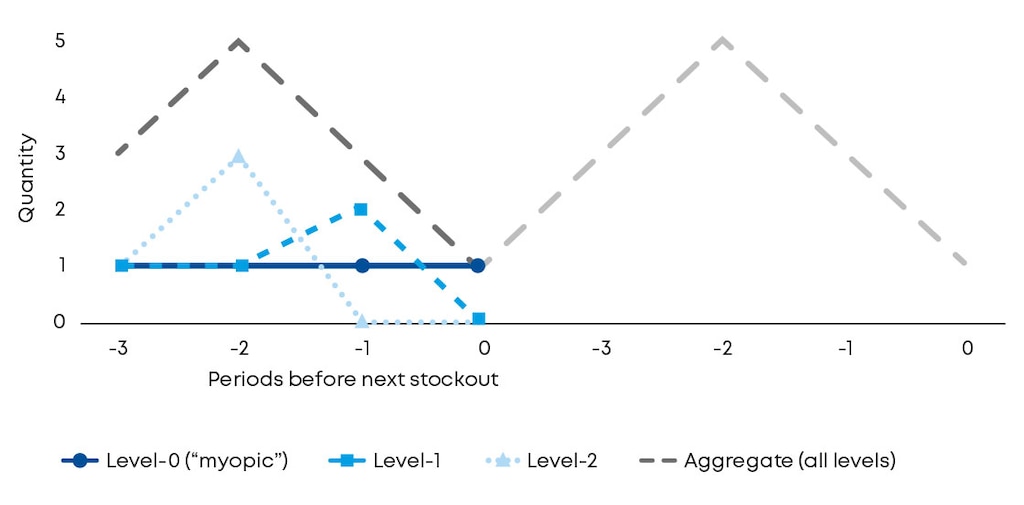
Example of one myopic and two forward-looking buyers
As a result, the buyers’ aggregated orders increase as the supplier’s inventory declines, peaking two periods before the stockout. This illustrates that the supplier’s demand can be shaped by the inventory information shared with the buyers if those buyers behave in a forward-looking manner.
Experiment results
In our incentivized experiment, we employed a 2 × 2 design with two policies (continuous vs. periodic inventory) and two service configurations (high vs. low fill rate). Subjects, acting as competing buyers, had to make repeated-purchase decisions to satisfy their requirements in each period. Throughout the experiment, subjects received updated information about the supplier’s inventory.
We found that the scarcity effect is strong for the low service level, with orders increasing by up to 58% for the periodic inventory policy and 38% for the continuous inventory policy. Interestingly, the scarcity effect is also clearly prominent for the high service level. This reveals that buyers are susceptible to shortages. We conclude that a supplier’s service level and the policy type indeed influence customer behavior and that:
- if regular stockouts occur, the scarcity effect is more pronounced for the periodic inventory policy.
- the scarcity effect decreases if the fill rate increases.
Many buyers are forward-looking, purchasing products before a potential stockout
Furthermore, the experimental results demonstrate that stockout-induced scarcity leads to demand peaks before inventory becomes scarce. All demand peaks occur for stock levels higher than the mean demand, indicating that forward-looking behavior strongly drives decisions. A detailed analysis shows that many buyers are forward-looking, purchasing products before a potential stockout. While some buyers order myopically, the majority take a forward-looking approach and act as Level-1 buyers, purchasing products one period before a potential stockout.
From the buyers’ perspective, stockout-induced scarcity behavior — ordering more than required in earlier periods — decreases the risk of an individual being unable to meet their requirements. At the same time, it increases the risk that other buyers cannot cover their requirements.
Demand: Biased by inventory management
The experimental results provide evidence that a company supplying a group of buyers making repeated-purchase decisions might influence its demand based on the chosen inventory control policy. Moreover, the periodic inventory policy generates more pronounced scarcity behavior than the continuous inventory policy, particularly for low fill rates.
Our findings have several managerial implications for real-world settings, where supplier stock levels are shaped by inventory policy and customer demand but also by factors such as lead time variations, upstream stock, and production decisions. Our work reveals that buyers do not act myopically and are swayed by the inventory information provided by the supplier. In particular, our study demonstrates a major advantage of the continuous policy for low service levels. This inventory policy reduces the effect of the behavioral response and thus smooths demand variation while providing more precise information about actual demand — assets for any supplier.
Our study contributes to inventory management research, which typically assumes stock-related decisions do not directly impact demand. By challenging this assumption, we have shown how demand can become influenced by inventory decisions, turning what is usually considered exogenous into endogenous. Moreover, we have demonstrated that stockout-induced demand growth is strongest before inventory reaches its minimum. In turn, once stock is low, forward-looking scarcity behavior results in low demand.
Authors of the research:
- Sebastian Schiffels. Professor, Business Analytics & Operations Cluster, Faculty of Business and Economics, University of Augsburg (Germany).
- Christian Jost. Research Associate, Faculty of Business and Economics, University of Augsburg (Germany).
Original publication:
Schiffels, S., Jost, C. The role of scarcity behavior in inventory management. European Journal of Operational Research, Vol 328, Issue 1, Pages 78-90. Elsevier B.V. (2026).
© 2025 The Authors. Published under CC BY 4.0 license.