


Reverse logistics helps reduce waste, optimize materials, and improve profitability in the transition to cleaner, more circular production
IN-DEPTH ANALYSIS
By Alicia Martínez de Yuso and Beatriz Royo
Industrial clusters, key drivers of employment and wealth in Europe, face significant challenges in adopting industrial symbiosis (IS). IS fosters collaboration among traditionally fragmented industries to share energy, water, by-products, infrastructure, and services. Its main goal is to minimize environmental impact while adding economic and social value, thus contributing to the backbone of the circular economy.
However, despite the EU’s strategic priorities for sustainable regional development, many industrialized areas struggle to implement IS on a large scale due to challenges such as:
- Shared use of technology and infrastructure.
- Integration of waste streams.
- Efficient energy and material management.
- Inclusion of surrounding ecosystems for social benefits.
Environmental and economic hurdles aside, citizens living near these clusters often face the consequences of a polluted environment, emphasizing the urgent need for sustainable configurations. IS plays a central role in reducing the consumption of virgin materials and waste generation while promoting sustainable development.
Circular economy: Definition and principles
As defined by Kirchherr et al. (2017), the circular economy replaces the "end-of-life" concept in the traditional linear model with the reduction, reuse, recycling, and recovery of materials in production and consumption processes. This system operates at three levels: micro (products and companies), meso (eco-industrial parks), and macro (cities, regions, and beyond). The goal is to achieve environmental quality, economic prosperity, and social equity for current and future generations.
The well-known butterfly diagram illustrates the continuous flow of materials in a circular economy, guided by three core principles:
- Eliminate waste and pollution.
- Keep products and materials in use at their highest value.
- Regenerate natural systems.
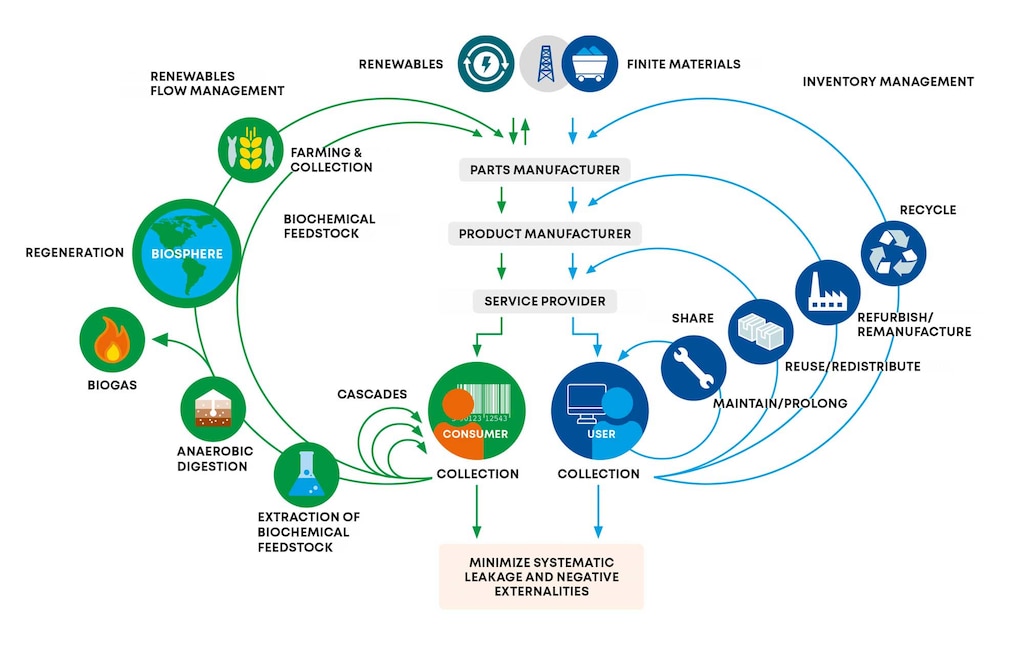
Circular economy butterfly diagram from the Ellen MacArthur Foundation
Based on the work of Braungart & McDonough, Cradle to cradle (C2C)
The circular economy not only fosters sustainability but also shifts from material-intensive to labor-intensive economies, boosting local economic activity through product remanufacturing and reuse. The following figure illustrates its main benefits.
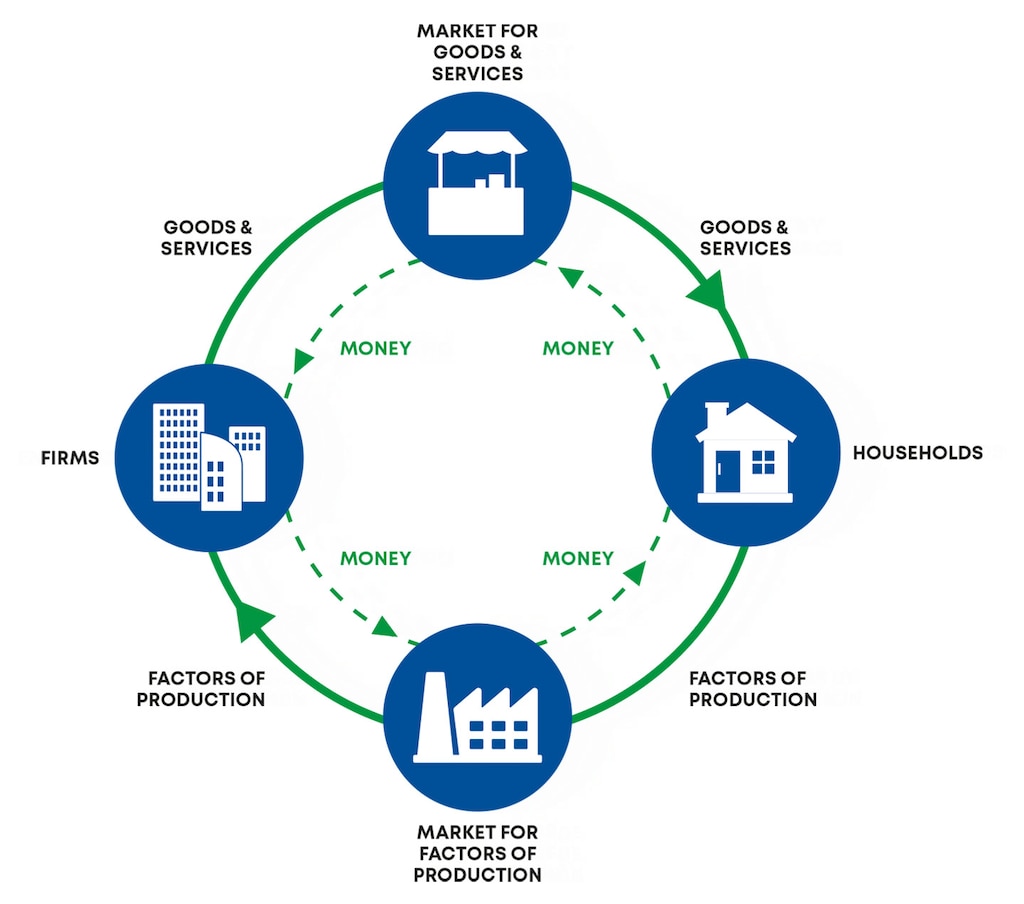
Benefits of the circular economy
Source: Work by Beatriz Royo and Alicia Martínez de Yuso
Reverse logistics: Key to circular supply chains
Reverse logistics plays a critical role in the circular economy. It enables the efficient flow of materials, in-process inventory, and semi-finished goods from customers along the supply chain back to their origin for reuse or recycling.
Reverse logistics improves sustainability by lowering energy use and emissions, increasing competitiveness under financial, socio-economic, legal, and political pressures. However, integrating recovered goods into existing networks poses challenges, requiring redesigns of infrastructure and logistical processes.
Paradigm shift: From linear to circular systems
The circular economy represents a fundamental shift in economic thinking, aiming to decouple growth from resource consumption. This transformation envisions a system designed to minimize waste and maximize resource utility through strategies like remanufacturing, reuse, and servitization.
Achieving this shift depends on several key enablers. Products and processes must be redesigned for durability, repairability, and disassembly, with innovative engineering approaches facilitating material recovery while maintaining functionality. Modular design, standardized components, and recycled material integration play a decisive role. Equally important is promoting responsible consumption and a culture of reuse, repair, and participation in circular systems. These efforts must be supported by policies, education, and business collaboration.
| Access vs. ownership: Do we consume the products or do we use them? | |
|---|---|
ECONOMY
|
ENVIRONMENT
|
BUSINESS
|
SOCIETY
|
Business models: Circular economy opportunities
The circular economy fosters innovative business models that prioritize resource retention and sustainability. One major opportunity lies in servitization, where companies shift from selling products to offering them as services. For instance, instead of selling appliances, retailers might provide them under service contracts, ensuring ongoing maintenance and repair.
This model minimizes material consumption, extends product lifespans, and generates jobs in sectors like remanufacturing and maintenance, particularly benefiting local economies. It focuses on extending product lifecycles through refurbishment and component recovery. By disassembling goods to salvage valuable materials, companies reduce waste and dependency on raw resource extraction. This labor-intensive approach is often conducted locally, supporting regional job creation while reducing environmental impact.
Lastly, supply chains play a pivotal role in advancing circularity. Implementing industrial symbiosis within logistics networks enables resource sharing and waste reutilization across industries. This not only strengthens supply chain resilience but also reduces environmental footprints, creating a sustainable foundation for economic growth.
Circular hub models: Ecosystems of the circular economy
Across Europe, various industrial hubs have embraced the principles of the circular economy and established themselves as dedicated hubs for circularity (H4C). These ecosystems foster resource recovery, remanufacturing, and industrial symbiosis, creating collaborative environments where waste streams from one sector become valuable inputs for another. The IS2H4C (Sustainable circular economy transition: From industrial symbiosis to hubs for circularity) model exemplifies this by promoting inter-industry collaboration to optimize logistics flows, share resources, and minimize waste generation.
In Spain, the H4C in Bilbao stands out as a prominent example in the highly industrialized Basque region. Focused on achieving decarbonization by 2050, this hub integrates core industries like steel, cement, lime, oil refining, and pulp and paper. To achieve this, it leverages advanced technologies such as wastewater treatment, pyrolysis, and electrolysis to produce e-fuel, capture CO₂, and replace fossil fuel inputs. These initiatives validate solutions like carbon capture and utilization (CCU), hydrogen, and oxyfuel in industrial settings.
These hubs act as testbeds for innovative circular solutions, providing practical insights into their scalability and real-world impact.
Supply chain models: Integrating industrial symbiosis
While these hubs showcase promising industrial symbiosis applications, their successful implementation depends on well-structured supply chain models. This applies especially to carbon capture from energy-intensive industries and the transition to hydrogen-based technologies. Both face considerable uncertainties regarding implementation, scalability, long-term feasibility, and sustainability impact.
Focusing on the construction industry, one key initiative is capturing and utilizing carbon emissions from the cement production process, where around 25% of output results from calcination. A notable example under analysis by the Basque Circular Hub is the carbonation of steel slags to produce carbonated slags. While this presents clear environmental benefits, adopting such a circular business model introduces substantial challenges.
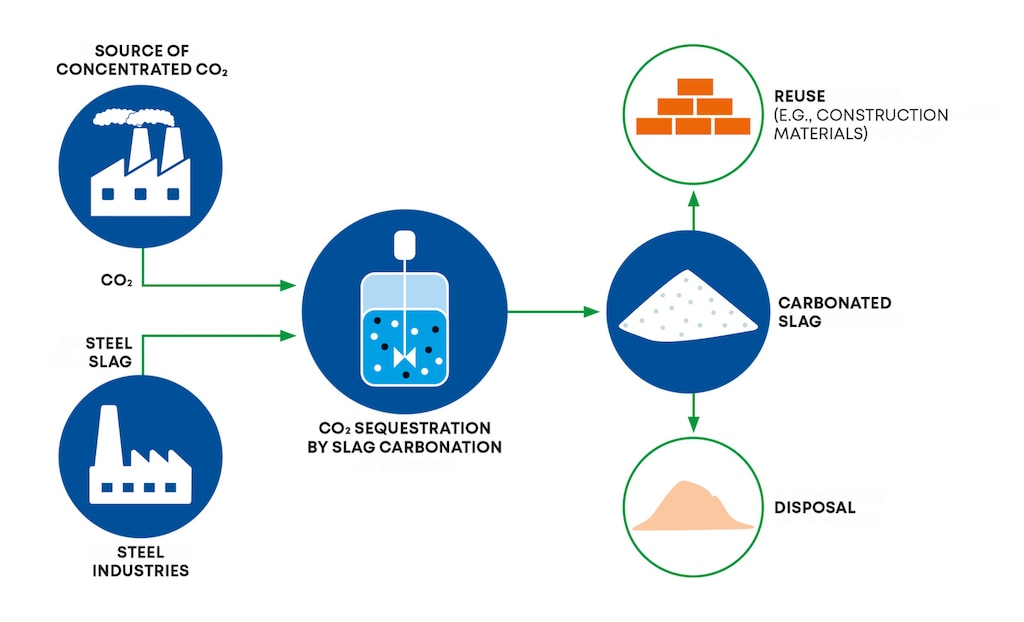
Carbonated slags from carbon capture and utilization and steel slags
Source: Shashikant & Anurag, 2017
Traditional linear supply chains operate as demand-driven pull systems, assuming unlimited material availability. In contrast, circular models introduce additional uncertainties, including:
- Market unpredictability. Demand for a non-existent product is uncertain, requiring a shift from traditional push-based supply chains.
- Supply fluctuations. Availability of raw materials depends on industrial waste streams, requiring efficient logistics and storage strategies.
- Financial feasibility. Reverse flows demand additional investments, potentially increasing costs and reducing competitiveness against well-established alternatives.
The success of this new business model hinges on feasibility and collaborative efforts across multiple stakeholders. Public and local governments play a role in subsidizing local industries, while EU regulations and the carbon market influence adoption through policy frameworks and incentives. Understanding these interdependencies is essential for ensuring a sustainable and scalable transition, not only within the construction sector but also across other industries and regions.
To navigate these complexities, quantitative modeling techniques are instrumental in identifying systemic interdependencies, informing policy decisions, and designing sustainable supply chains. System dynamics (SD) models simulate how complex systems evolve. They offer insights into three main areas:
- Economic trade-offs of CCU adoption.
- Influence of policy changes.
- Long-term feasibility of market-driven sustainability solutions.
Yu et al. (2023) combined SD and discrete event simulation (DES) to quantify environmental and economic trade-offs in a circular economy application. The study focused on recycling aramid-based fibers, a by-product of Tequila production, by mixing them with PBT plastics to reduce CO₂ emissions. The study revealed that full-scale integration had the highest reduction in CO₂ emissions but came at a higher cost. A targeted stakeholder approach, focusing on specific actors like packaging manufacturers, proved to be more cost-effective while still delivering incremental environmental benefits.
In summary, the combined use of SD and DES provides a powerful toolset for evaluating the feasibility of circular economy initiatives. By integrating these modeling approaches, policymakers and industry leaders can proactively balance profitability, resource efficiency, and environmental impact, ensuring that circular supply chains remain both economically viable and scalable.
Moving toward effective implementation
The circular economy, industrial symbiosis, and reverse logistics are key components in building circular supply chains. However, their successful implementation requires managing considerable uncertainties related to material availability, demand fluctuations, regulatory frameworks, and economic feasibility. Quantitative modeling plays a crucial role in navigating these complexities by simulating different scenarios, evaluating risk factors, and optimizing decision-making.
Authors of the analysis:
 |
Alicia Martínez de Yuso Alicia Martínez de Yuso is a Project Manager at the Zaragoza Logistics Center (ZLC). With extensive experience in environmental topics, she contributes to innovative projects in the circular economy, industrial symbiosis, supply chains, urban mobility, and AI, providing strategic, sustainable, and resilient solutions. |
 |
Beatriz Royo Dr. Beatriz Royo is an Associate Professor at the MIT-Zaragoza International Logistics Program (Spain). Dr. Royo’s main research areas are urban mobility, network design, supply chain collaboration, digitalization, and sustainability. |
References:
- Kirchherr, J., Reike, D., Hekkert, M. Conceptualizing the circular economy: An analysis of 114 definitions. Resources, Conservation and Recycling, Vol. 127, pp. 221–232 (2017).
- Ellen MacArthur Foundation. Circular economy system diagram (February 2019). Drawing based on Braungart & McDonough, Cradle to Cradle (C2C).
- Ellen MacArthur Foundation. Towards the circular economy: Economic and business rationale for an accelerated transition. (2013).
- Sustainable circular economy transition: From industrial symbiosis to hubs for circularity (IS2H4C). Project funded by the Horizon Europe Program of the European Union.
- Fernando, Y., Shaharudin, M.S., Abideen, A.Z. Circular economy-based reverse logistics: Dynamic interplay between sustainable resource commitment and financial performance. European Journal of Management and Business Economics, Vol. 32, Issue 1, pp. 91–112 (2023).
- Tukker, A. Product-services for a resource-efficient and circular economy – A review. Journal of Cleaner Production, Vol. 97, pp. 76–91 (2015).
- Shashikant, Y., Anurag, M. Experimental study of dissolution of minerals and CO₂ sequestration in steel slag. Waste Management, Vol. 64, pp. 348–357 (2017).
- Stahel, W. R. The circular economy. Nature, Vol. 531, Issue 7595, pp. 435–438 (2016).
- Yu, J., Hieu, T., Gray, S., Encinas-Oropesa, A. A bi-objective decision support tool based on system dynamics and discrete event modelling for sustainable supply chain. Journal of Circular Economy, Vol. 1, Issue 3 (2023).